🦤 The 100 Weirdest Animals in the World (The Internet’s BIGGEST LIST Ever!)
Nature never ceases to amaze us with its incredible diversity.
While lions 🦁, elephants 🐘, and dolphins 🐬 capture our hearts, some of Earth’s most fascinating creatures are the ones that make us do a double take.
Get ready to pick your jaw up off the floor as you explore our list of the 100 strangest animals on Earth, each one a testament to evolution’s wild imagination.
1. Blobfish
The blobfish has earned its reputation as one of the world’s ugliest animals, but there’s more to this deep-sea dweller than meets the eye.
Living at depths of 2,000- to 3,900-feet (600-1,200 m) off the coasts of Australia, New Zealand, and Tasmania, this gelatinous fish has adapted perfectly to extreme underwater pressure.
What makes the blobfish truly weird is that it looks completely different in its natural habitat. At depth, it appears relatively normal.
However, when brought to the surface, the sudden pressure change causes its body to expand into the droopy, blob-like appearance we’ve all seen in photos.
This fascinating adaptation allows the blobfish to float just above the seafloor without expending energy swimming.
Its lack of muscle mass is actually a survival advantage in the deep ocean where food is scarce.
The blobfish feeds on whatever edible matter floats by, from crustaceans to mollusks.
Despite its unfortunate appearance out of water, this strange animal plays an important role in maintaining the balance of deep-sea ecosystems.
2. Axolotl
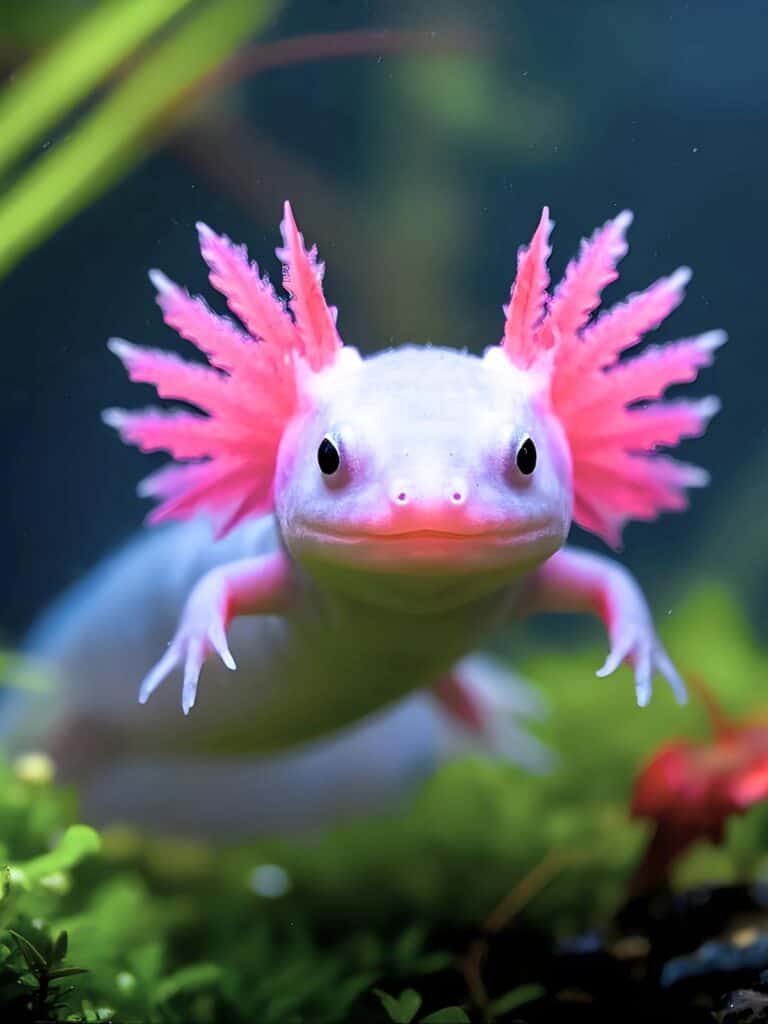
Often called the “Mexican walking fish,” the axolotl isn’t actually a fish at all but an amphibian with extraordinary powers.
This unusual animal remains in its larval form throughout its entire life, a phenomenon called neoteny, keeping its feathery external gills and aquatic lifestyle even as an adult.
What truly sets the axolotl apart is its remarkable regenerative abilities — as they’re famous for being able to regrow their brain 🧠
These bizarre creatures can regrow entire limbs, parts of their spinal cord, heart tissue, and can even regrow portions of their brain.
Scientists study axolotls extensively, hoping to unlock the secrets of regeneration for human medicine.
Native to the canals and lakes of Xochimilco near Mexico City, wild axolotls are critically endangered due to habitat loss and water pollution.
In captivity, however, they’ve thrived and come in various colors including pink, white, golden, and black.
Their perpetual smile and cute appearance have made them popular pets, though they require specific care to survive.
3. Saiga Antelope

The saiga antelope looks like someone started sculpting a normal antelope, and then accidentally dropped an elephant trunk on its face.
This formerly-critically endangered species from the grasslands of Central Asia has a bulbous, drooping nose that seems comically oversized for its head.
That bizarre nose serves important purposes.
The enlarged nasal passages filter out dust during the dry summer months and warm cold air during harsh winters when temperatures plummet to a frigid -40° 🥶
4. Goblin Shark
The goblin shark is a living nightmare from the deep sea 🦈
This rare species has translucent pink skin, a long pointed snout, and jaws that shoot forward like something from the Alien movies.
It’s the only surviving member of the Mitsukurinidae family, a lineage dating back 125 million years.
Growing up to 13 feet long (4 m), goblin sharks inhabit deep waters where sunlight never penetrates.
Their unusual pink coloration comes from blood vessels visible through translucent skin.
That protruding snout is packed with electroreceptors that detect the faint electrical signals produced by prey in complete darkness.
When prey comes close, the goblin shark’s jaws extend forward in a fraction of a second, creating suction that pulls victims directly into its mouth.
This specialized feeding mechanism, combined with its ghostly appearance, makes the goblin shark one of the ocean’s strangest predators.
Scientists rarely observe these elusive sharks, and much about their behavior remains mysterious.
5. Star-Nosed Mole

Possibly the origin of the expression “a face only a mother could love,” the star-nosed mole has one of the most bizarre faces in the animal kingdom.
Its nose is surrounded by 22 fleshy, pink tentacles arranged in a star pattern, giving it an otherworldly appearance that seems almost alien.
Those tentacles aren’t just for show.
They contain more than 100,000 nerve fibers packed into a space smaller than your fingertip, making the star-nose the most sensitive touch organ of any mammal.
The mole uses this incredible sensory apparatus to identify and consume prey in less than a quarter of a second, making it the fastest eater on Earth.
Star-nosed moles are also one of the only mammals known to smell underwater.
They blow bubbles into water and quickly re-inhale them, capturing scent particles in the process.
Living in wetlands and marshes across North America, these unusual creatures spend their lives in darkness, relying entirely on their remarkable star-nose to navigate and hunt.
6. Proboscis Monkey

The male proboscis monkey has a nose so large and droopy it often hangs below its chin.
This unusual primate from the island of Borneo gets its name from its pendulous proboscis, which can grow up to seven inches long.
That ridiculous nose isn’t just for looks (or laughs 🤪).
It serves as a resonating chamber that amplifies the monkey’s mating calls, making males with larger noses more attractive to females.
The nose also swells and turns red when the monkey is excited or agitated, serving as a visual signal to other monkeys.
Proboscis monkeys are excellent swimmers with partially webbed feet, unusual for primates.
They’ve been observed making belly flops into water from heights of 50-feet (15 m) to escape predators.
Living in mangrove forests and riverine areas, these strange monkeys feed primarily on leaves, fruits, and seeds.
Habitat loss has made them endangered, with populations declining as Borneo’s forests disappear more and more with each passing year.
7. Leafy Sea Dragon

The leafy sea dragon looks like a piece of drifting seaweed brought to life.
Native to the waters of southern Australia, this relative of seahorses has elaborate leaf-like appendages covering its entire body, creating one of nature’s most impressive camouflages.
These ornate projections serve no purpose in locomotion.
Instead, the leafy sea dragon propels itself using nearly transparent fins that are almost invisible as they flutter.
This allows the creature to drift through kelp forests looking exactly like floating vegetation, making it nearly impossible for predators to spot.
Male leafy sea dragons carry fertilized eggs on a special brood patch under their tail, similar to their seahorse cousins.
They belong to the only animal family where the males get pregnant and give birth, along with seahorses and pipefish 🫃
These rare creatures are protected by Australian law, and divers must maintain a distance to avoid disturbing them.
Their otherworldly appearance has made them icons of marine conservation.
8. Venezuelan Poodle Moth
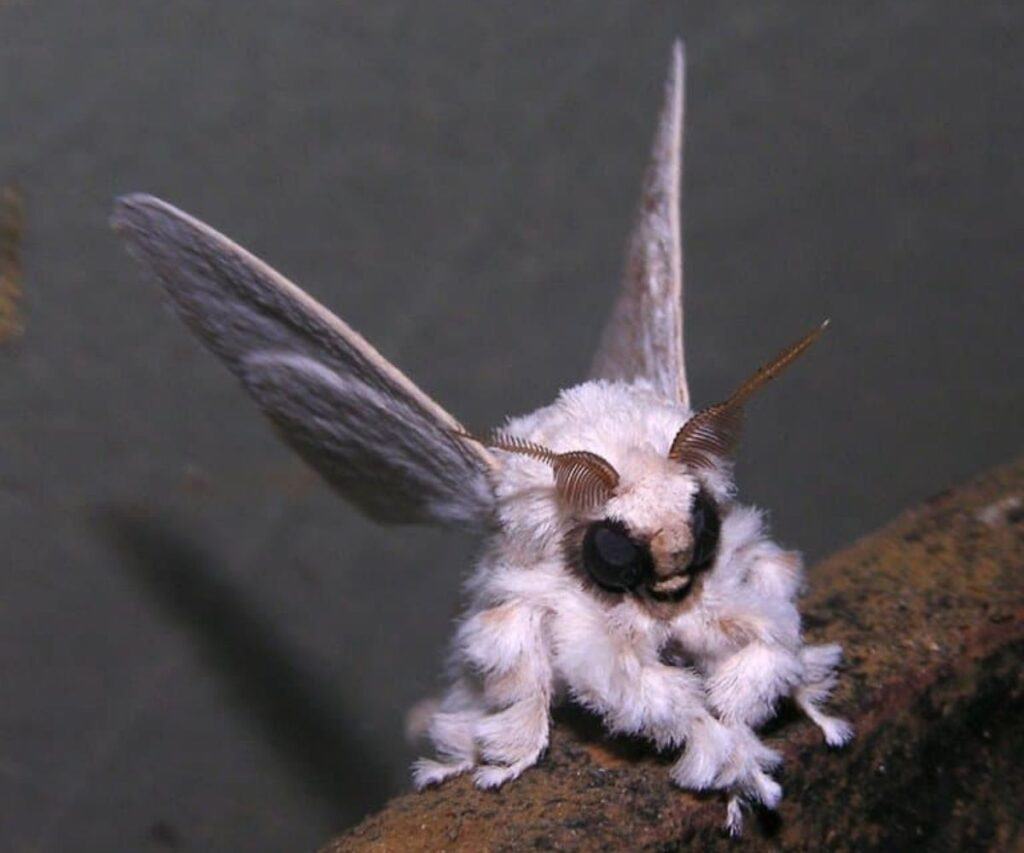
Discovered in Venezuela in 2009, the Venezuelan poodle moth quickly became an internet sensation for its bizarre appearance.
This unusual insect is covered in dense white fur that gives it an uncanny resemblance to a tiny flying poodle.
Very little is known about this strange species since its recent discovery, as scientists are still studying its behavior, habitat preferences, and life cycle.
The thick fur likely serves as insulation in the cool mountain forests where it was found, though researchers are still investigating its exact purpose.
Some experts initially questioned whether the poodle moth was real or an elaborate Photoshop creation.
However, it belongs to a known group of moths called Artace, which includes several fuzzy species.
The Venezuelan poodle moth’s extreme fluffiness makes it one of the most unusual insects discovered in recent decades.
Its cute-yet-alien appearance demonstrates that nature still has surprises in store!
9. Anglerfish
The deep-sea anglerfish is the stuff of nightmares, with massive jaws, needle-like teeth, and a bioluminescent lure dangling from its head.
This bizarre predator uses its glowing lure to attract prey in the pitch-black depths of the ocean.
The lure, called an illicium, contains bioluminescent bacteria that produce light.
Hungry fish swim toward what they think is a meal, only to be snapped up by the anglerfish’s enormous mouth.
Some species have jaws that can unhinge, allowing them to swallow prey larger than themselves.
Perhaps the strangest thing about anglerfish is their mating behavior. Males are tiny compared to females, sometimes 60 times smaller.
When a male finds a female, he bites into her body and fuses permanently, essentially becoming a parasitic sperm sac.
His organs degenerate until only the reproductive system remains. Some females carry multiple males attached to their bodies simultaneously.
This extreme sexual dimorphism is one of nature’s most unusual reproductive strategies.
10. Shoebill Stork
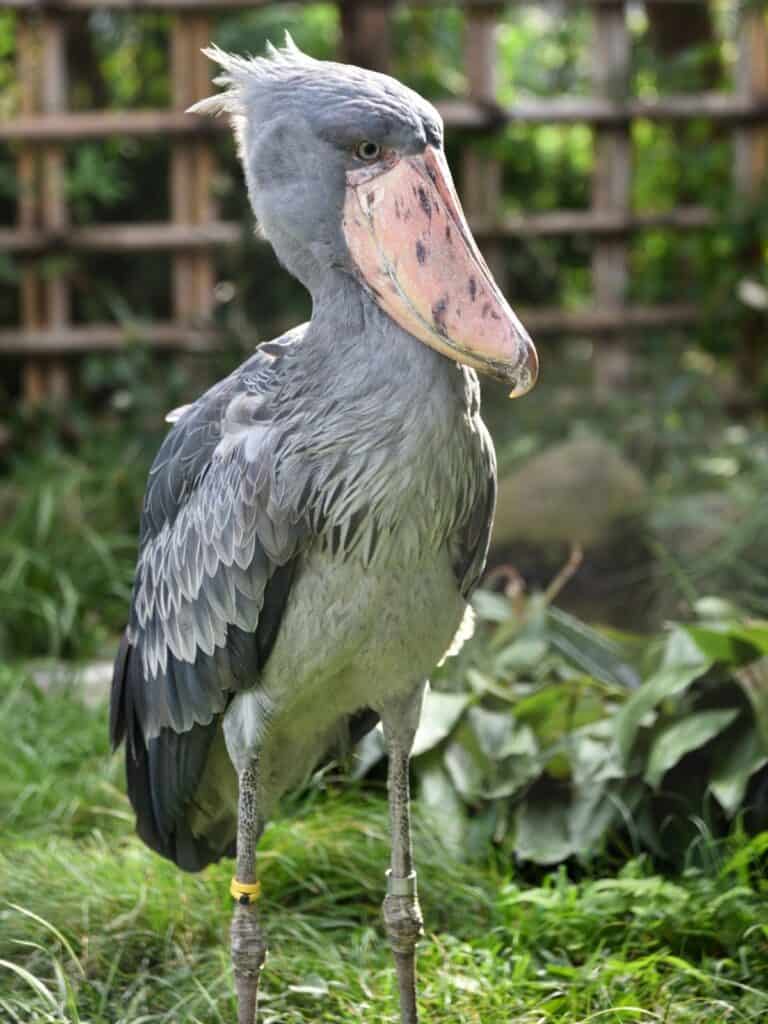
The shoebill looks like a dinosaur that forgot to go extinct 🦖
Standing five-feet-tall (1.5 m) with a massive shoe-shaped bill, this African bird has an intense, unblinking stare that’s both captivating and unsettling.
Its bill can grow to nine-inches-long (23 cm) and is powerful enough to decapitate a catfish in one snap — which is why it’s one of the world’s scariest birds.
Shoebills are patient hunters, standing motionless for hours waiting for prey to surface.
When a lungfish, water snake, or young crocodile comes within range, the shoebill strikes with explosive speed and precision.
They’ve been observed killing baby crocodiles and decapitating them before swallowing 😳
These strange birds are found in the swamps of East Africa, where habitat loss has made them vulnerable.
Solitary and territorial, nesting pairs maintain large territories.
Despite their fierce appearance, shoebills occasionally bow to humans who bow to them first, showing a surprisingly polite side.
If their appearance wasn’t strange enough, they also have an unusual habit of defecating on their own legs to cool down.
This behavior is called urohidrosis, and it’s seen in other birds as well.
Shoebills, turkey vultures, white storks, condors, gannets, boobies, and other species living in warm environments do this to manage extreme heat.
11. Glass Frog

Glass frogs have translucent skin on their bellies that reveals their internal organs, beating hearts, and developing eggs.
These remarkable amphibians from Central and South America look like living anatomy lessons, with bones, organs, and blood vessels visible through their see-through skin.
The transparent belly serves as camouflage.
When resting on leaves, glass frogs’ green backs blend in from above while their translucent undersides make them nearly invisible from below.
Predators looking up see right through them to the leaf behind, making the frog effectively disappear.
Male glass frogs are devoted fathers, guarding eggs on leaves overhanging streams.
When tadpoles hatch, they drop into the water below to complete their development.
There are more than 150 species of glass frogs, each with varying degrees of transparency.
Some species have bones that appear bright green due to bile pigments, adding to their alien appearance.
These unusual frogs are threatened by habitat loss as tropical forests disappear.
12. Babirusa
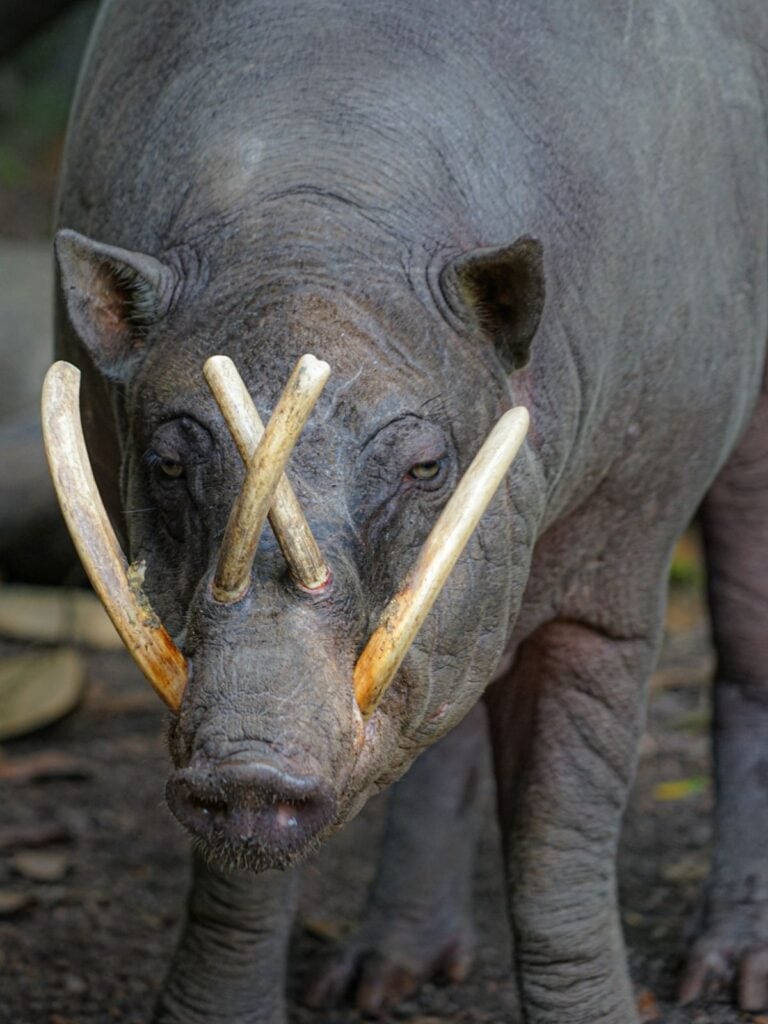
The babirusa is a type of wild pig from Indonesia with tusks that grow so long they can curve backward toward the animal’s own skull (and in rare cases, pierce it).
These bizarre tusks grow continuously throughout the babirusa’s life, emerging through the skin of the snout rather than from the mouth.
Males have four tusks total 🦷
The lower canines grow upward from the jaw like normal tusks, while the upper canines grow backward through the top of the snout, curving toward the forehead.
Scientists aren’t entirely sure what purpose these strange tusks serve, as they’re too fragile for fighting, and too awkwardly positioned for digging.
For now, they’re seen as purely ornamental, used only to display dominance within competing males.
The name babirusa means “pig-deer” in Malay, referring to the tusk’s resemblance to antlers.
These unusual animals live in rainforests and swamps, feeding on fruits, leaves, and roots.
They’re excellent swimmers and have been observed swimming between islands in Indonesia.
Habitat loss and hunting have made babirusas vulnerable, with some subspecies critically endangered.
13. Aye-Aye

The aye-aye looks like something straight out of a horror movie 😬 especially in photos with the flash on that makes their eyes look almost evil.
This nocturnal primate from Madagascar has bulging eyes, bat-like ears, and a skeletal middle finger that would make E.T. jealous.
It’s the world’s largest nocturnal primate and one of the most unique animals on the planet as the aye-aye’s bizarre middle finger serves a specific purpose.
Using a hunting technique called percussive foraging, which is also used by woodpeckers, it taps on tree bark to locate hollow spaces where grubs hide.
Once detected, the aye-aye gnaws through the wood with its continuously growing rodent-like teeth, then uses that elongated finger to extract its meal.
In Madagascan culture, aye-ayes are considered bad omens.
Local superstition holds that if an aye-aye points its skeletal finger at you 🫵 death is near.
This unfortunate reputation has led to aye-ayes being killed on sight in some regions, contributing to their endangered status.
Conservation efforts are working to change perceptions of these remarkable primates.
14. Peacock Mantis Shrimp

Don’t let the name fool you; the mantis shrimp is neither a mantis nor a shrimp, but it is one of the ocean’s most incredible predators.
This colorful crustacean packs one of the fastest punches in the animal kingdom.
The mantis shrimp can strike with its club-like appendages at speeds of 50 mph (80 km/h), creating cavitation bubbles that reach temperatures approaching the surface of the sun 🌞
This powerful strike can crack open crab shells with ease, and in captivity, has been known to shatter aquarium glass!
Some species use sharp spears instead of clubs to impale soft-bodied prey — but even more impressive than their hunting prowess, are their eyes.
Mantis shrimp have the most complex visual system of any animal, with 16 color receptors compared to humans’ measly three.
They can see ultraviolet and polarized light, giving them a view of the world we can barely imagine.
Their eyes also move independently of each other, so they can look in two directions at once.
These strange adaptations make the mantis shrimp a truly alien creature sharing our oceans 👽
15. Naked Mole Rat

The naked mole rat may be one of nature’s most successful evolutionary experiments, even if it looks like a raw hotdog with teeth 🌭
These bizarre mammals from East Africa have seemingly cracked the code on longevity and disease resistance.
Naked mole rats can live more than 30 years, which is extraordinary for rodents of their size.
They don’t age in the traditional sense, maintaining reproductive capability and showing no increase in mortality risk as they get older.
They’re also remarkably resistant to cancer, can survive 18 minutes without oxygen, and feel almost no pain from acid or heat.
These strange creatures live in underground colonies structured like bee hives.
A queen mole rat dominates the colony, breeding with only a few males while worker mole rats dig tunnels and gather food.
This eusocial behavior is extremely rare among mammals, shared only with the closely related Damaraland mole rat.
Despite their unsettling appearance, naked mole rats are teaching scientists valuable lessons about aging, cancer prevention, and survival in extreme conditions.
16. Hagfish

The hagfish is probably the slimiest creature on Earth, capable of producing enough mucus to fill a bucket in seconds 🤧
When threatened, this eel-like fish secretes sticky slime that can clog a predator’s gills, effectively choking them.
What makes hagfish truly weird is their anatomy.
They have a skull but no true backbone, can absorb oxygen through their skin, and can tie themselves in knots.
This knotting behavior helps them remove slime from their own bodies and provides leverage when tearing chunks of flesh from carcasses.
Hagfish are scavengers that burrow into dead or dying animals on the ocean floor, often showing up in massive numbers to get the job done fast.
These ancient fish have remained virtually unchanged for more than 300 million years, making them living fossils.
Some scientists don’t even classify hagfish as true vertebrates due to their lack of a backbone.
Their unusual biology and extreme slime production make them fascinating subjects for biomaterial research.
17. Duck-Billed Platypus

When European naturalists first encountered the platypus in 1798, they thought it was an elaborate hoax.
This strange animal from Australia has a duck’s bill, a beaver’s tail, otter feet, lays eggs like a reptile, and produces venom.
It seemed impossible that one creature could combine so many different features, which is why they thought the animal was an elaborate hoax.
Male platypuses have venomous spurs on their hind legs that deliver a cocktail of toxins causing excruciating pain that can last for weeks 😩
This makes them one of the few venomous mammals on Earth.
Their leathery bill contains electroreceptors that detect the electrical signals produced by muscle contractions in prey, allowing them to hunt underwater with their eyes closed.
The platypus is one of only two egg-laying mammals, the other being the echidna.
After hatching, baby platypuses nurse from milk patches on their mother’s belly since she lacks nipples.
This bizarre combination of reptilian and mammalian characteristics makes the platypus a unique window into evolution.
Despite their odd appearance, platypuses are excellent swimmers and important parts of Australian freshwater ecosystems.
18. Coconut Crab

The coconut crab is the world’s largest land arthropod, with a leg span reaching three-feet-across (1 m) and weighing up to nine pounds (4 kg).
These massive crustaceans from Indo-Pacific islands have claws powerful enough to crack open coconuts, their favorite food 🥥
Despite being a type of hermit crab, adult coconut crabs don’t live in shells.
Instead, they’ve developed a hardened exoskeleton that protects them from predators.
They’re excellent climbers, scaling palm trees to harvest coconuts and hiding in burrows or rock crevices during the day.
Their sense of smell is remarkably acute, comparable to a dog’s ability to detect even faint scents from miles away.
There’s a macabre theory that coconut crabs may have scavenged the remains of Amelia Earhart after her plane crashed in 1937.
These opportunistic scavengers will eat almost anything, including other coconut crabs.
On some Pacific islands, they’re considered a delicacy despite their intimidating appearance and powerful claws.
19. Lamprey

The lamprey is a living nightmare that’s remained virtually unchanged for more than 300 million years.
This jawless, parasitic fish has a circular mouth filled with concentric rows of razor-sharp teeth that it uses to latch onto other fish and suck their blood like a vampire 🧛🏻♂️
Once attached, lampreys rasp through scales and skin with a toothed tongue, secreting anticoagulants to keep blood flowing.
They can remain attached for days, slowly draining their host.
Some fish survive these attacks, bearing distinctive circular scars, while others don’t make it.
Native lampreys play important roles in aquatic ecosystems, but invasive sea lampreys in the Great Lakes have devastated fish populations since the 1800s.
These strange parasites can grow up to 3-feet-long (1 m) and have caused millions of dollars in damage to commercial fisheries.
Despite control programs, they remain one of the most destructive invasive species in North America.
Others on that list include the Africanized honeybee, Burmese python, lionfish, black carp, Siberian moth, and wild boar.
20. Sea Pig
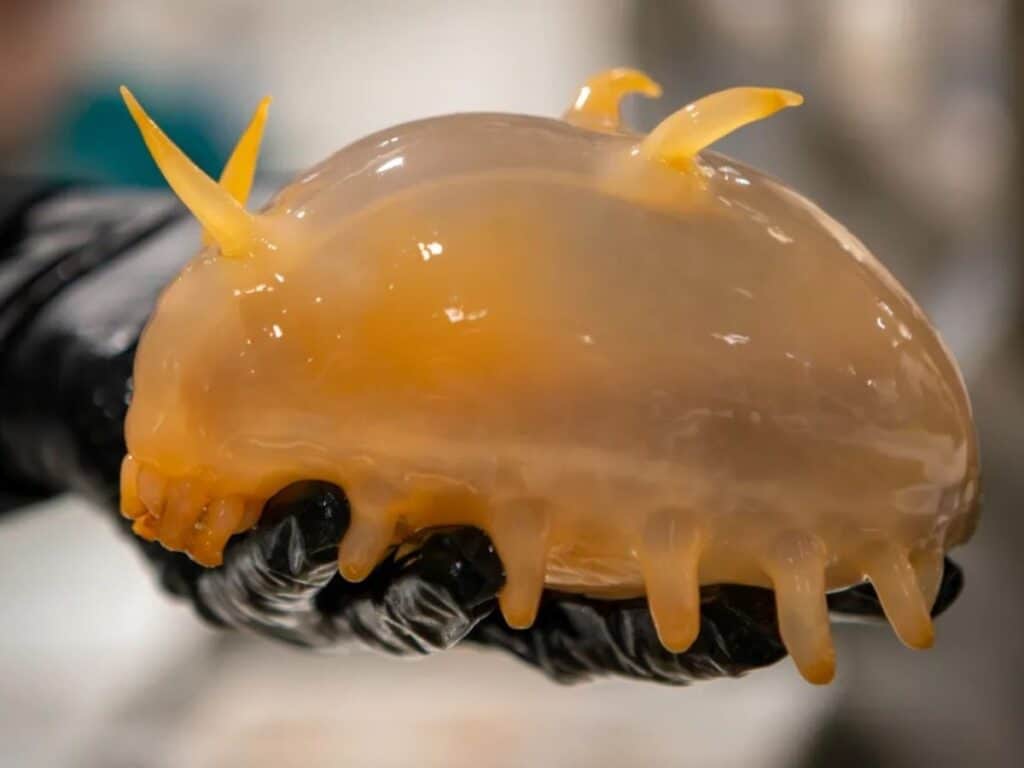
The sea pig isn’t actually a pig but a type of sea cucumber that waddles across the ocean floor on inflated tube feet.
These bloated, pink creatures look like something from a science fiction movie, with translucent skin revealing their internal organs.
Living at depths of 3,000- to 20,000-feet-deep (915 to 6,100 m), sea pigs use their tube feet to walk across the abyssal seafloor, searching for organic particles that sink from above.
When a whale carcass or other large food source lands on the ocean bottom, hundreds of sea pigs gather for the feast, using tentacles around their mouths to shovel food in.
Sea pigs pump water through their bodies to maintain their inflated shape at extreme depths.
If brought to the surface, they shrivel up and die from the pressure change.
These strange scavengers play a crucial role in deep-sea ecosystems, recycling nutrients that would otherwise remain locked in dead organic matter.
Despite living in one of Earth’s most extreme environments, sea pigs are surprisingly abundant.
21. Pink Fairy Armadillo
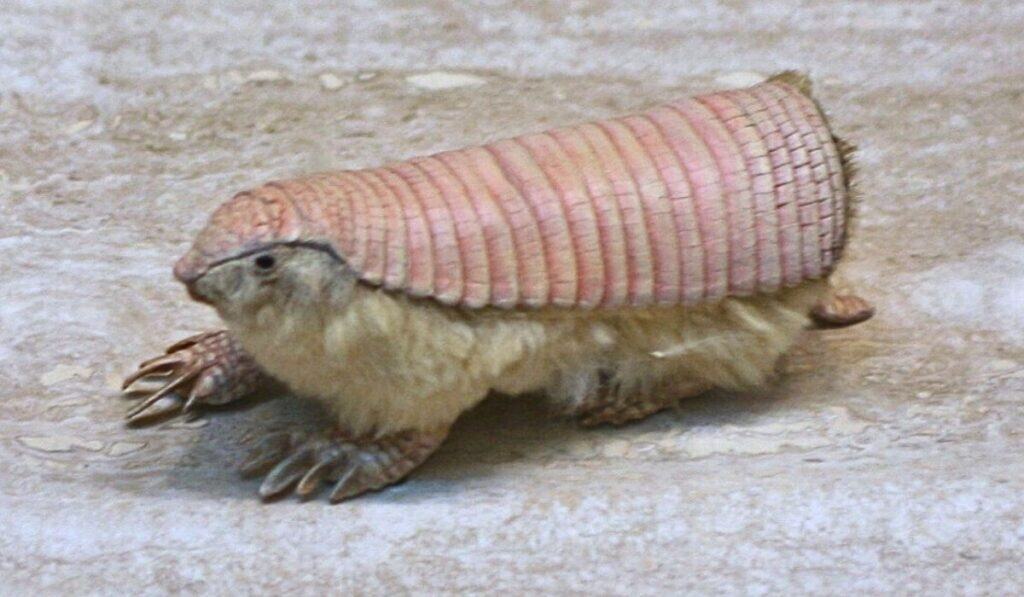
The pink fairy armadillo is the smallest armadillo species and one of the strangest mammals in South America.
Measuring just 4- to 6-inches-long (10-15 cm), this tiny creature has pink armor plates covering its back and a fuzzy white body underneath.
Unlike other armadillos, the pink fairy armadillo’s shell isn’t fully attached to its body.
The plates are connected by a thin membrane and flexible enough to allow the animal to squeeze through narrow burrows.
It spends almost its entire life underground in the sandy plains of central Argentina, earning the nickname “sand swimmer” for its ability to navigate through soil.
These elusive animals are rarely seen by humans. They emerge only at night and are extremely sensitive to stress, often dying when removed from their burrows.
They’re so rarely seen that scientists don’t know how many pink fairy armadillos are left in the wild.
The IUCN lists them as Data Deficient, meaning there isn’t enough information to judge how threatened they are 🥺
Habitat loss from farming is a likely threat, as it is for many other cute animals that are endangered.
The pink fairy armadillo’s shy nature and underground lifestyle make them one of the least understood mammals on Earth.
22. Fossa

The fossa is Madagascar’s top predator — and one of the most bizarre carnivores on Earth.
It looks like a cross between a cat, a dog, and a mongoose, with a long body, stubby legs, and a tail nearly as long as its body.
Fossas are the only predators large enough to hunt adult lemurs, which make up much of their diet.
These agile hunters are equally comfortable in trees and on the ground, with retractable claws and flexible ankles that allow them to climb down trees headfirst.
They can leap between branches with remarkable precision, but what makes fossas truly weird is their mating behavior.
Females mate with multiple males over several days while perched in trees, sometimes 60-feet (18 m) off the ground.
Young fossas are born in tree hollows and stay with their mothers for more than a year.
These strange animals are found nowhere else on Earth and are threatened by habitat loss as Madagascar’s forests shrink.
23. Gerenuk Antelope
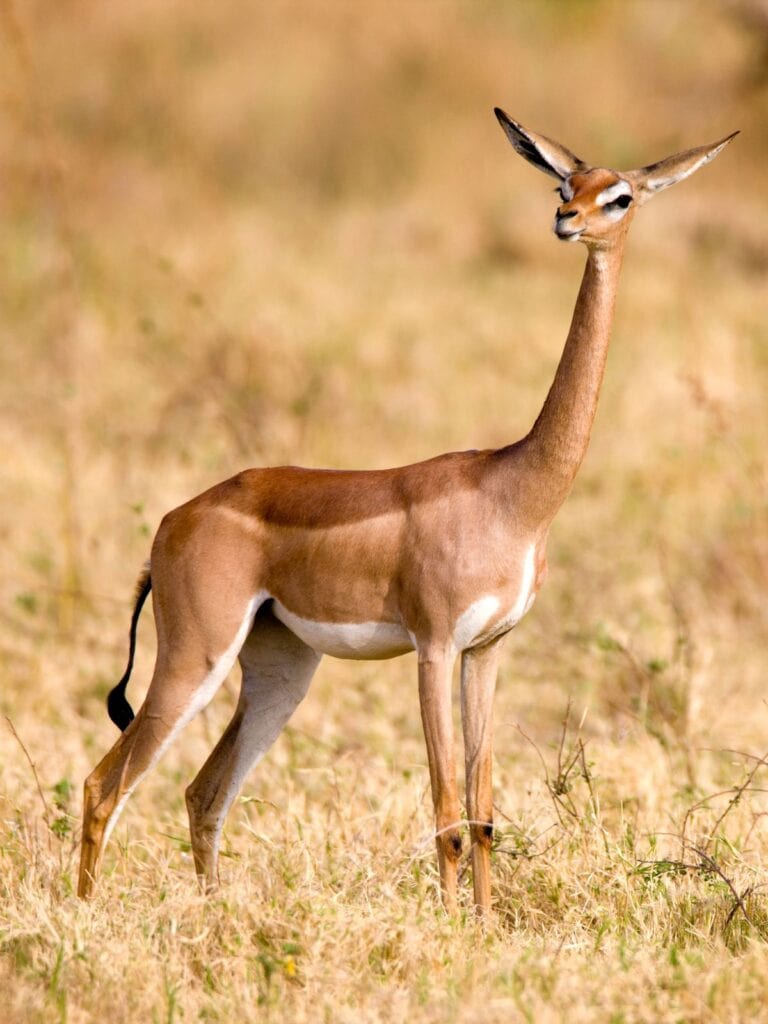
The gerenuk is an antelope that looks like someone stretched a regular gazelle’s neck on a taffy puller 🤪
This bizarre animal from East Africa has an extraordinarily long neck and stands on its hind legs to reach leaves high in trees, giving it the nickname “giraffe gazelle.”
Gerenuks can reach vegetation seven-feet (2 m) off the ground by standing upright, a behavior almost unheard of among antelopes.
Their long necks allow them to reach food sources at the top of trees that are otherwise unavailable to competitors.
Remarkably, gerenuks never need to drink water, as they get all necessary moisture from the plants they eat.
This unique adaptation allows them to survive in arid environments.
Male gerenuks sport impressive curved horns, while females are hornless.
These slender antelopes have large eyes and ears that give them excellent awareness of their surroundings.
Living in small groups across Kenya, Tanzania, and Somalia, gerenuks face threats from habitat loss and hunting.
Their unusual appearance and behavior make them one of Africa’s most distinctive antelopes.
24. Dumbo Octopus

The dumbo octopus gets its name from the ear-like fins protruding from its head, giving it an uncanny resemblance to Disney’s flying elephant in the Dumbo movie.
These deep-sea dwellers are among the cutest weird animals on the planet — and though they are undeniably cute, the emphasis here is on “deep-sea dwellers.”
Living at depths of 10,000- to 13,000-feet-deep (3,000 to 3,900 m), dumbo octopuses are the deepest-living octopuses known.
They flap their ear-like fins to propel themselves through the water, hovering just above the seafloor in search of prey.
Unlike shallow-water octopuses, dumbo octopuses swallow their prey whole, feeding on snails, worms, and crustaceans.
There are at least 15 species of dumbo octopus, ranging in size from 8-inches to 6-feet-long (20 cm to 1.8 m).
They lack the ink sacs that most octopuses use for defense since predators are scarce in the deep ocean.
These unusual cephalopods can change color and texture instantly, a trait shared with their shallow-water cousins.
Their adorable appearance belies the fact that they’re perfectly adapted predators in one of Earth’s most extreme environments.
25. Pangolin

The pangolin is the world’s only mammal covered entirely in scales, looking like a walking pine cone.
These shy, nocturnal creatures from Africa and Asia are covered in hard keratin scales, the same material that makes up your fingernails and hair.
When threatened, pangolins roll into a tight ball, with their sharp-edged scales forming impenetrable armor.
Even lions and leopards can’t unroll a defensive pangolin 🙀
They have no teeth and use incredibly long, sticky tongues to lap up ants and termites. A single pangolin can consume more than 70 million insects per year!
Tragically, pangolins hold the devastating title of world’s most trafficked mammal.
More than one million have been poached in the past decade for their scales, which are falsely believed to have medicinal properties in traditional medicine.
All eight pangolin species are threatened or endangered 🥺
Conservation efforts are working to protect these strange animals, but illegal trafficking remains a major threat.
26. Japanese Spider Crab
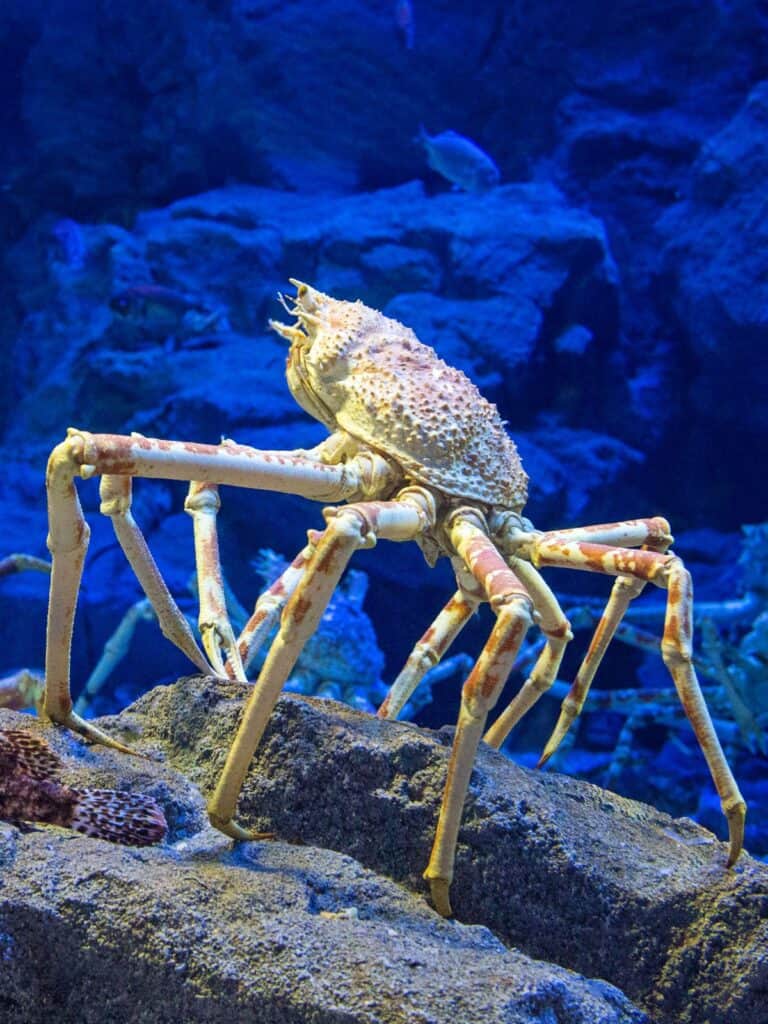
The Japanese spider crab is the largest arthropod on Earth, with a leg span reaching up to 12-feet (3.6 m) and weighing up to 40 pounds (18 kg).
These massive crustaceans look like something from a monster movie, with spindly legs extending from a relatively small body.
Despite their frightening appearance, Japanese spider crabs are gentle scavengers that feed on dead plants and animals on the ocean floor.
They can live up to 100 years in deep waters off Japan’s coast.
Young crabs are more colorful with orange bodies, while adults develop a darker, rust-colored appearance that helps them blend into rocky seafloors.
These bizarre crustaceans are considered a delicacy in Japan, where they’re caught during specific seasons.
Some specimens are kept in aquariums, where their enormous size never fails to impress visitors.
Their long legs move slowly and deliberately, giving them an eerie, otherworldly appearance.
Female spider crabs can carry up to 1.5 million eggs at once, ensuring the survival of these ancient-looking creatures 🕷️
27. Hoatzin
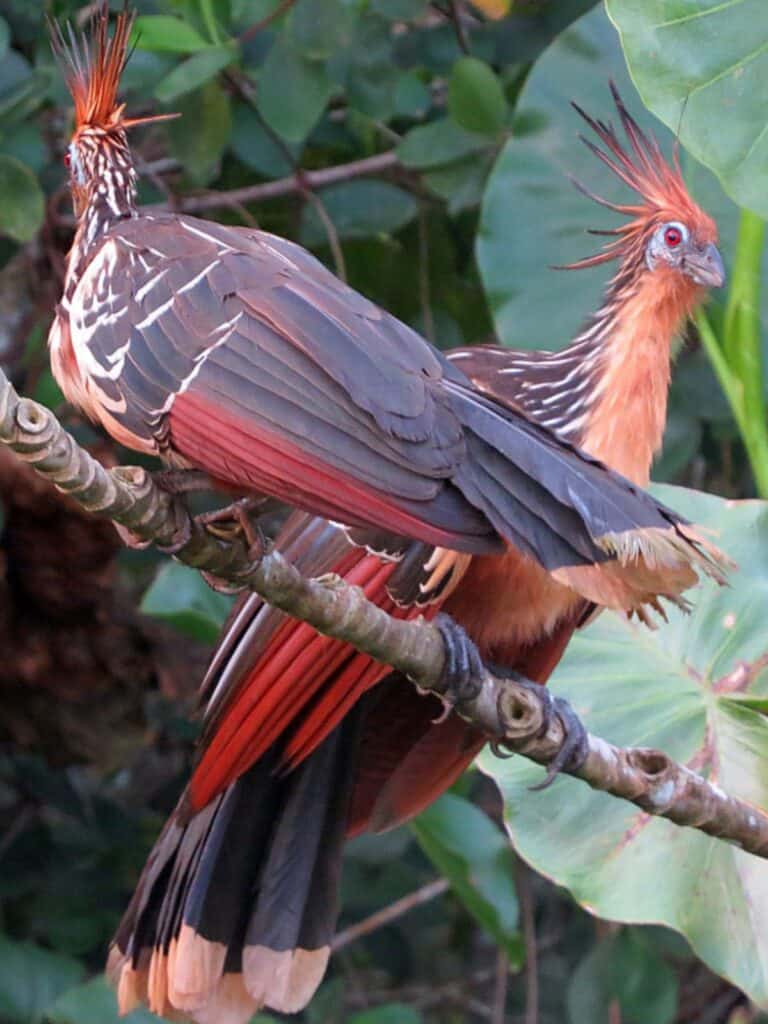
The hoatzin is one of the weirdest birds in South America, earning the nickname “stinkbird” for its manure-like odor 💩
This unusual smell comes from the bacterial fermentation of leaves in its specialized crop, similar to how cows digest grass.
Born with claws on their wings that allow them to climb trees if they fall from the nest, baby hoatzins are even stranger than adults!
These claws will eventually disappear as the birds mature, and become better at not falling.
If threatened, young hoatzins drop into water and swim away, using their wing claws to climb back up when danger passes.
Hoatzins have difficulty flying due to their reduced flight muscles, which have been partially replaced by an enlarged crop for fermenting vegetation.
They spend most of their time in trees along riverbanks, eating leaves and digesting them slowly.
Their peculiar digestive system makes them one of the few birds that can survive on a diet of only leaves 🍃
The hoatzin’s combination of strange features makes it unlike any other bird on Earth.
28. Narwhal

The narwhal, often called “the unicorn of the sea,” is actually one of the world’s most mysterious whale species and one of the ocean’s most unusual creatures in general.
Male narwhals sport a long, spiral tusk that can grow up to 10-feet-long (3 m), giving them a mythical appearance 🦄
This tusk is actually an elongated tooth that grows through the upper lip.
Scientists once believed the tusk was used for fighting or breaking ice, but recent research suggests it’s a sensory organ.
The tusk contains millions of nerve endings that can detect changes in water temperature, pressure, and salinity.
Males may also use their tusks in mating displays and to establish dominance hierarchies.
Narwhals live in Arctic waters around Canada, Greenland, and Russia, diving to depths of 5,000-feet (1,525 m) to hunt fish and squid.
They travel in groups called pods and communicate using clicks, whistles, and knocks. Climate change threatens narwhals as Arctic ice melts, altering their habitat and food sources.
29. Okapi
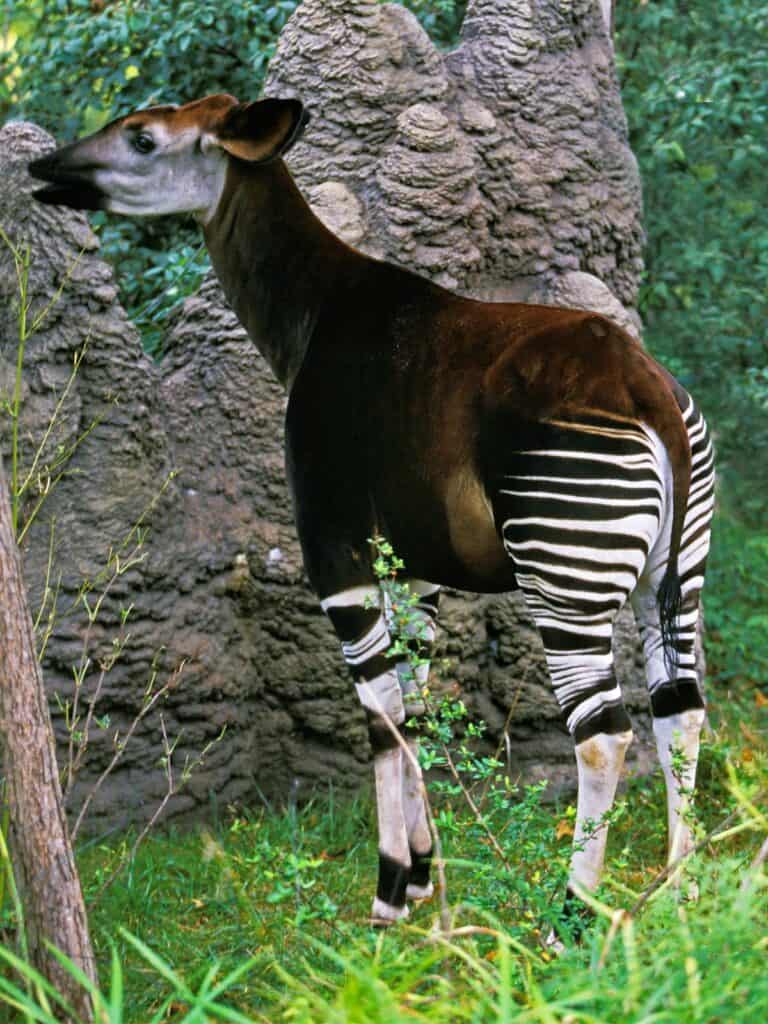
The okapi looks like someone tried to create a zebra, but ran out of stripes halfway through.
This unusual animal from the Democratic Republic of Congo has the head and body of a short-necked giraffe with zebra-striped legs.
Despite its zebra-like stripes, the okapi is actually the giraffe’s closest living relative. The stripes serve as camouflage in the dappled light of dense rainforests.
Okapis have extremely long, prehensile tongues that can reach up to 18-inches (46 cm) — long enough to clean their own eyelids and ears 🙀
These solitary browsers are so elusive that scientists didn’t confirm their existence until 1901, and locals called them “African unicorns.”
Okapis have large ears that can rotate independently to detect predators in the thick forest.
Oil-producing glands on their hooves leave scent trails that help okapis communicate.
Habitat loss and poaching have made okapis endangered, with fewer than 25,000 remaining in the wild.
30. Thorny Devil
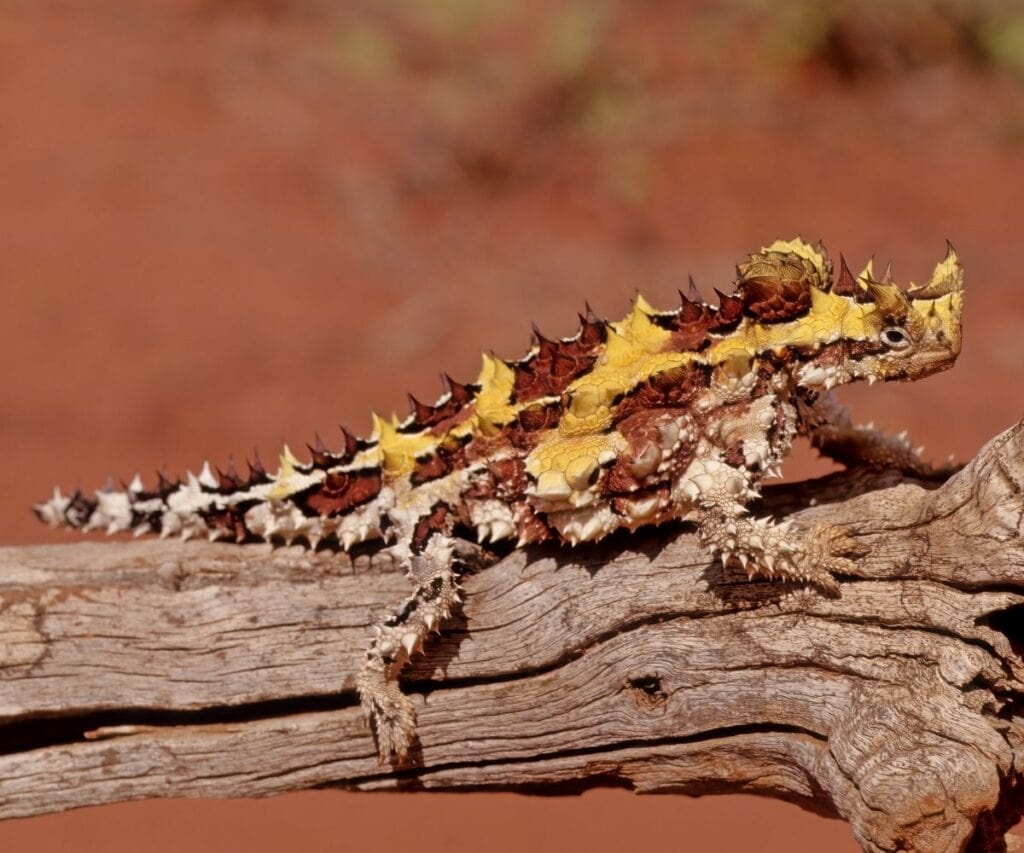
The thorny devil is a small Australian lizard covered head to tail in sharp spines, making it look like a tiny dragon.
These elaborate spikes aren’t just for defense, they also collect water in the desert through a network of microscopic grooves that channel moisture directly to the lizard’s mouth 💦
Thorny devils can drink through their feet by standing in dew or puddles, with water traveling up their legs to their mouth via capillary action.
They change color from pale yellow during hot weather to dark reddish-brown when it’s cool, helping regulate body temperature.
When threatened, they tuck their heads between their front legs, presenting a false head on the back of their neck to confuse predators.
These unusual lizards eat nothing but ants, consuming thousands in a single day. They walk slowly with a distinctive gait, rocking back and forth as they move.
Native to central Australia’s arid regions, thorny devils can live for up to 20 years.
Their elaborate defenses and water-collection system make them perfectly adapted to survive in one of Earth’s harshest environments.
31. Tapir

Tapirs are herbivorous mammals that look like a cross between a pig, a baby elephant, and an anteater, with stocky bodies and distinctive prehensile snouts.
These ancient animals have remained relatively unchanged for millions of years, earning them the title of living fossils.
Their flexible, trunk-like snout can grasp branches and strip leaves, making them expert foragers in the dense jungles and forests they inhabit.
Tapirs are excellent swimmers and often take to water to escape predators or cool off in the tropical heat.
Despite their pig-like appearance, tapirs are more closely related to horses and rhinoceroses.
They play a crucial role in seed dispersal, earning them the nickname “gardeners of the forest.”
Baby tapirs are absolutely adorable, covered in white stripes and spots that help them blend into the dappled forest light.
These markings fade as they mature into adults.
Found in Central and South America, as well as Southeast Asia, all four tapir species face threats from habitat loss and hunting.
The Malayan tapir (pictured above) is particularly distinctive, with a black and white coloration that looks like someone draped a white blanket over its middle.
32. Flying Fox
Flying foxes aren’t foxes at all — they’re enormous fruit bats with heads that resemble a fox’s face, complete with pointed ears and large, intelligent eyes.
These megabats can have wingspans reaching up to 5-feet (1.5 meters), making them the largest bats in the world.
Unlike their insect-eating cousins, flying foxes feast on nectar, pollen, and fruit, playing a vital role as pollinators and seed dispersers in tropical and subtropical forests.
A single colony can contain thousands of individuals hanging upside down from tree branches.
Flying foxes navigate using their excellent vision and sense of smell rather than echolocation.
They’re highly social animals, often engaging in loud screeching conversations with their colony mates.
These gentle giants can fly up to 30 miles (48 km) in a single night in search of fruiting trees, making them essential to forest regeneration across vast areas.
Found throughout Australia, Southeast Asia, and islands of the Indian and Pacific Oceans, flying foxes face threats from habitat destruction and are sometimes persecuted by orchard owners.
However, they’re crucial to maintaining healthy ecosystems.
33. Capybara

The capybara is the world’s largest rodent, resembling a giant guinea pig and weighing up to 140 pounds (65 kg).
Native to South America, capybaras have partially webbed feet perfect for swimming in rivers, lakes, and wetlands.
They’re highly social creatures, living in groups of 10-20 individuals, though herds of more than 100 have been observed.
These gentle, semi-aquatic mammals have become internet darlings thanks to their calm demeanor and tendency to befriend other animals.
Capybaras are remarkably chill animals, often photographed with birds, monkeys, and even crocodilians resting on their backs.
Their relaxed nature has made them unofficial mascots of tranquility ☮️
These herbivores spend much of their day grazing on grasses and aquatic plants.
They’re also known to eat their own feces, a behavior that helps them extract maximum nutrients from their plant-based diet.
In their native habitat, capybaras must watch out for jaguars, caimans, and anacondas.
However, their biggest threat comes from habitat loss as wetlands are drained for agriculture and development.
34. Echidna

The echidna AKA spiny anteater is one of only two egg-laying mammals on Earth (the other being the platypus).
Despite their primitive appearance, they have a surprisingly large prefrontal cortex for their brain size.
Covered in sharp spines and coarse fur, these peculiar creatures look like a hedgehog crossed with an anteater.
Echidnas have incredibly long, sticky tongues that can extend up to 7 inches (18 cm) to lap up ants and termites.
They have no teeth, so they grind their food between the bottom of their mouth and their tongue.
When threatened, echidnas curl into a spiky ball or rapidly dig straight down into the ground, leaving only their impenetrable spines exposed.
They’re surprisingly strong diggers with powerful claws.
These solitary animals have poor vision but an excellent sense of smell and electroreception so they can detect the electrical signals produced by muscle contractions in their prey.
Found throughout Australia and New Guinea, echidnas are highly adaptable, living in deserts, forests, and even alpine regions.
Famed naturalist and everyone’s favorite narrator, Sir David Attenborough, even has one named after him.
Sir David’s long-beaked echidna is a critically endangered species that lives in the Cyclops Mountains near the northern coast of New Guinea.
35. Tarsier

Tarsiers are tiny primates with enormous eyes that can’t move in their sockets. Instead, they can rotate their heads 180° like owls.
Each eye is larger than their entire brain, giving these creatures a perpetually startled, alien appearance.
These carnivorous primates are the only fully predatory primates in the world, feeding on insects, lizards, and small birds.
They’re accomplished jumpers, able to leap 40 times their own body length between trees.
Tarsiers have extremely long fingers and toes with adhesive pads that help them grip branches.
Their ankles (tarsal bones) are elongated, which is how they got their name.
Tarsiers are so delicate that they can die from stress, making them completely unsuitable as pets.
In captivity, stressed tarsiers can injure themselves and often die young — a tragic testament to their need for wild habitats.
Found only in Southeast Asian islands including the Philippines, Borneo, and Sulawesi, these nocturnal primates are threatened by habitat loss and illegal pet trade.
Several species are critically endangered.
36. Kakapo

The kakapo is the world’s only flightless parrot, and one of the strangest birds on Earth.
These rotund, moss-green birds are nocturnal, ground-dwelling, and thought to live 60 years or more, making them among the longest-lived birds.
Kakapos are also the heaviest parrots in the world, weighing up to 9 pounds (4 kg).
Instead of flying, they climb trees using their beak and claws, then parachute down using their stubby wings.
These solitary birds have a strong, musty odor described as smelling like honey and flowers.
Males create bowl-shaped depressions in the ground and make deep booming calls that can travel more than three-miles (4.8 km) to attract females.
Kakapos were once abundant across New Zealand but became critically endangered after humans introduced predators like cats, rats, and stoats.
At one point, only 51 individuals remained 🥺
Thanks to intensive conservation efforts, the kakapo population has slowly increased.
Every single bird has a name and is monitored constantly by scientists. They’re a conservation success story in progress.
37. Colugo (Flying Lemur)
The colugo AKA flying lemur is neither a lemur nor capable of true flight — but it is one of nature’s most accomplished gliders.
These tree-dwelling mammals have a membrane of skin stretching from their neck to fingertips to toes to tail, creating a living kite.
Colugos can glide more than 200 feet (60 m) between trees, with minimal altitude loss, making them the most skilled gliding mammals on Earth.
When not airborne, they appear awkward and vulnerable on the ground, but in the trees, they’re remarkably graceful.
Native to Southeast Asia, these cat-sized animals spend virtually their entire lives in the forest canopy.
Their patchy, mottled fur provides excellent camouflage against tree bark.
Colugos are herbivores, feeding on leaves, shoots, flowers, and sap.
They have large eyes adapted for nocturnal vision and can rotate their heads nearly 180° to scan for predators.
Mothers carry their single baby in their membrane pouch for about six months.
During this time, the young colugo develops the skills needed for a life spent gliding through the rainforest.
38. Tardigrade (Water Bear)
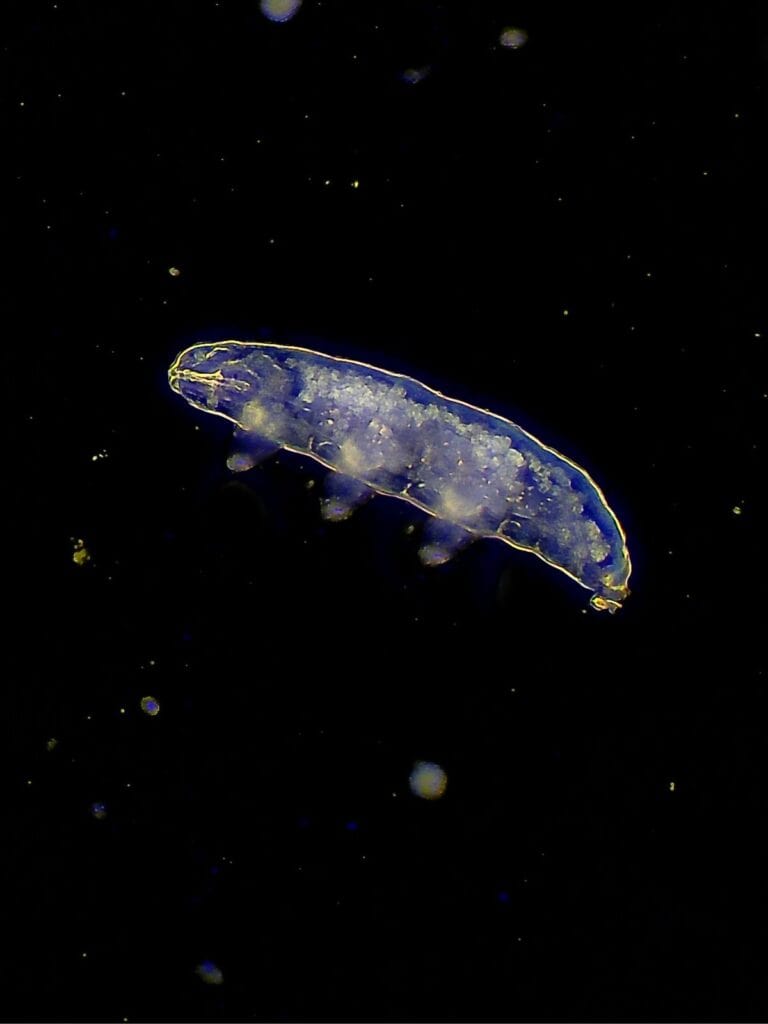
The microscopic tardigrade, also called a water bear, might be the toughest creature on Earth.
These eight-legged micro-animals can survive conditions that would kill virtually any other organism on the planet, including extreme temperatures from near absolute 0° to more than 300°F (149°C) 🌡️
They’ve survived the vacuum of space, exposure to radiation 1,000 times what would kill humans, and pressure six times that of the deepest ocean trenches.
They can go decades without food or water by entering a state called cryptobiosis, essentially dying and coming back to life when conditions improve.
Found everywhere from mountaintops to ocean trenches, tardigrades have been around for more than 500 million years.
Scientists discovered that tardigrades on the moon might still be alive after an Israeli spacecraft crashed there in 2019.
Their extraordinary resilience makes them invaluable for studying extreme survival and potential life on other planets.
39. Kinkajou
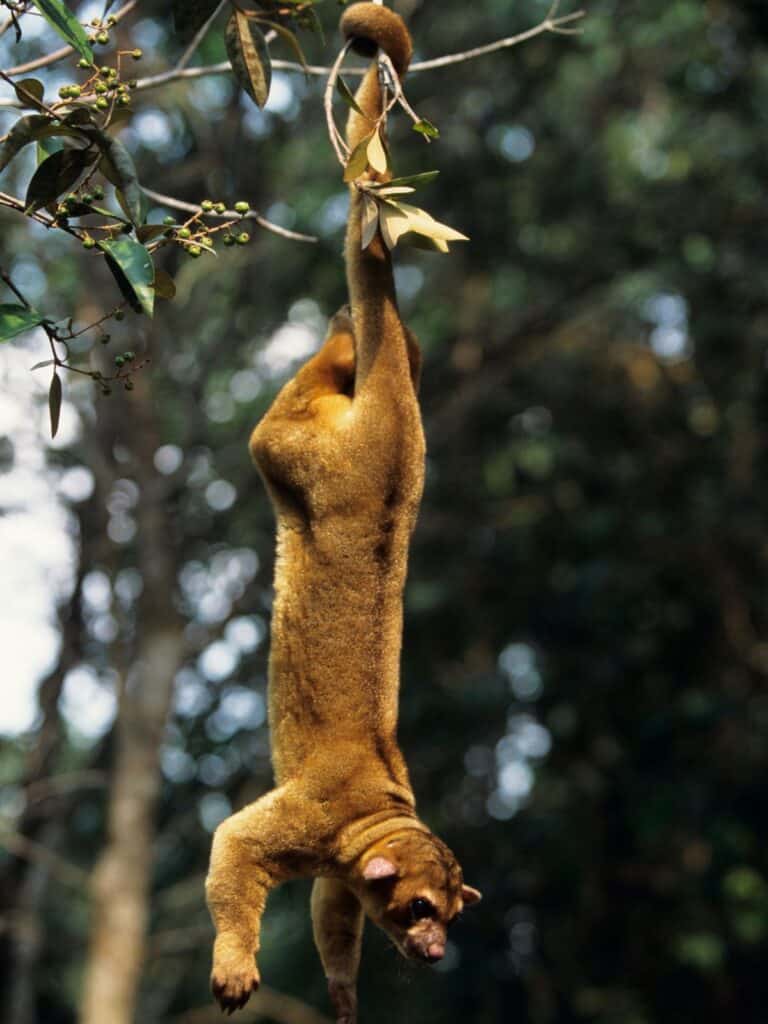
The kinkajou is a rainforest mammal related to raccoons, with a long prehensile tail it uses like a fifth hand to grip branches.
Often mistaken for primates, these adorable golden-furred animals are sometimes called “honey bears.”
Kinkajous have incredibly long tongues of up to 5 inches (13 cm), perfect for reaching inside flowers to lap up nectar.
They play an important role as pollinators, carrying pollen on their furry faces from flower to flower.
These nocturnal acrobats spend their entire lives in trees, rarely touching the ground.
They can rotate their feet backwards to run easily in either direction along branches and can hang from their tail alone.
Kinkajous are surprisingly vocal, making a range of sounds including barks, screams, and baby-like cries.
Despite their cute appearance, they have sharp teeth and can be aggressive when threatened.
Found from Mexico to Brazil, kinkajous face habitat loss as tropical forests are cleared.
They’re sometimes captured for the illegal pet trade, though their nocturnal nature and need for space make them unsuitable as pets.
40. Jaguarundi

The jaguarundi is a small wild cat with a long, weasel-like body and short legs, giving it an appearance quite unlike typical felines.
Its uniform coloring, ranging from gray to reddish-brown, and peculiar body shape, make it one of the most unusual-looking cats.
These secretive hunters are diurnal, unusual for wild cats, spending their days stalking rodents, birds, and reptiles through thick vegetation.
They’re excellent swimmers and aren’t afraid of water.
Jaguarundis have at least 13 distinct vocalizations, including purrs, whistles, chirps, and bird-like calls.
They’re more vocal than most other small wild cats.
Despite being widespread from Mexico to Argentina, jaguarundis are rarely seen due to their shy nature and preference for dense brush.
In the U.S., they’re likely gone entirely, as the last confirmed jaguarundi in Texas was found in 1986.
These adaptable cats can thrive in various habitats including tropical forests, grasslands, and even agricultural areas.
However, habitat fragmentation and loss of prey species pose ongoing threats to their populations.
41. Jerboa

Jerboas are tiny hopping rodents that look like a kangaroo crossed with a mouse, complete with enormous hind legs, long tufted tails, and oversized ears.
These desert-dwellers can jump up to 10-feet (3 m) in a single bound.
Their hind legs are four times longer than their front legs, allowing them to leap away from predators at speeds up to 15 mph (24 km/h).
When moving slowly, they walk on all fours, but when alarmed, they bounce away like tiny pogo sticks.
Found across the deserts of North Africa, Arabia, and Asia, jerboas have adapted remarkably to extreme environments.
They never need to drink water, getting all necessary moisture from the seeds and insects they eat.
Jerboas have incredible hearing, with ear canals that make up 15% of their skull.
This allows them to detect predators like owls and foxes in the dark desert night.
These nocturnal rodents spend their days in cool underground burrows, plugging the entrance with sand to maintain humidity and temperature.
Some species can enter torpor during extreme conditions to conserve energy.
42. Quokka

The quokka has been dubbed the world’s happiest animal due to its permanently upturned mouth that looks like a smile.
These cat-sized marsupials from Australia have become Instagram sensations thanks to their adorable appearance and friendly nature.
Quokkas are herbivores, feeding on grasses, leaves, and bark.
They’re most famous on Rottnest Island, where there are no foxes or feral cats, and quokkas have become used to people.
These marsupials can climb trees, something unusual for their size.
They also have the ability to regurgitate their food and chew it again, similar to cows.
There was an internet rumor going around that when threatened, mother quokkas throw their babies at predators to escape.
This shocking survival strategy sparked debate among wildlife enthusiasts, but has been debunked.
Quokkas are listed as vulnerable due to habitat loss, introduced predators like foxes and cats, and disease.
On the mainland, populations have declined significantly, making island sanctuaries crucial for their survival.
43. Potoo

The potoo is a bizarre nocturnal bird that looks like a cross between an owl and a broken tree branch.
During the day, it remains completely motionless in an upright position with its eyes nearly closed, perfectly mimicking a dead tree stump.
Potoos have enormous eyes with a notch in the eyelid that allows them to detect movement even when their eyes appear shut.
This gives them the ability to monitor predators while maintaining their camouflaged pose.
These strange birds have huge mouths that they use to catch flying insects at night.
When hunting, they sally forth from a perch to snatch moths and beetles from the air, then return to the same spot.
Potoos produce haunting, mournful calls that echo through tropical forests at night.
Various cultures have folklore about these birds, often associating them with sadness or death.
Found from Mexico to Argentina, these solitary birds nest on the tops of tree stumps, laying a single egg directly on the wood with no nest material.
Their incredible camouflage makes them nearly impossible to spot during the day.
44. Red-Lipped Batfish

The red-lipped batfish looks like it raided a makeup counter and decided to go heavy on the lipstick.
This strange fish from the Galápagos has bright red lips that make it appear perpetually ready for a night out.
These fish are terrible swimmers and prefer to “walk” along the ocean floor using modified pectoral fins as legs.
They’re actually quite clumsy, looking like they’re stumbling around underwater.
The red lips are thought to help attract mates 💋 though their exact purpose remains a mystery.
As the fish matures, its lips become even more vibrant.
Red-lipped batfish have a horn-like projection called an illicium on their forehead that lures small prey.
They feed on small fish, shrimp, mollusks, and crabs.
Found in the waters around the Galápagos Islands and off Peru, these bizarre fish live at depths of 10 to 250-feet (3-76 m).
They’re not considered threatened, but their limited range makes them vulnerable to environmental changes.
45. Rosy Maple Moth
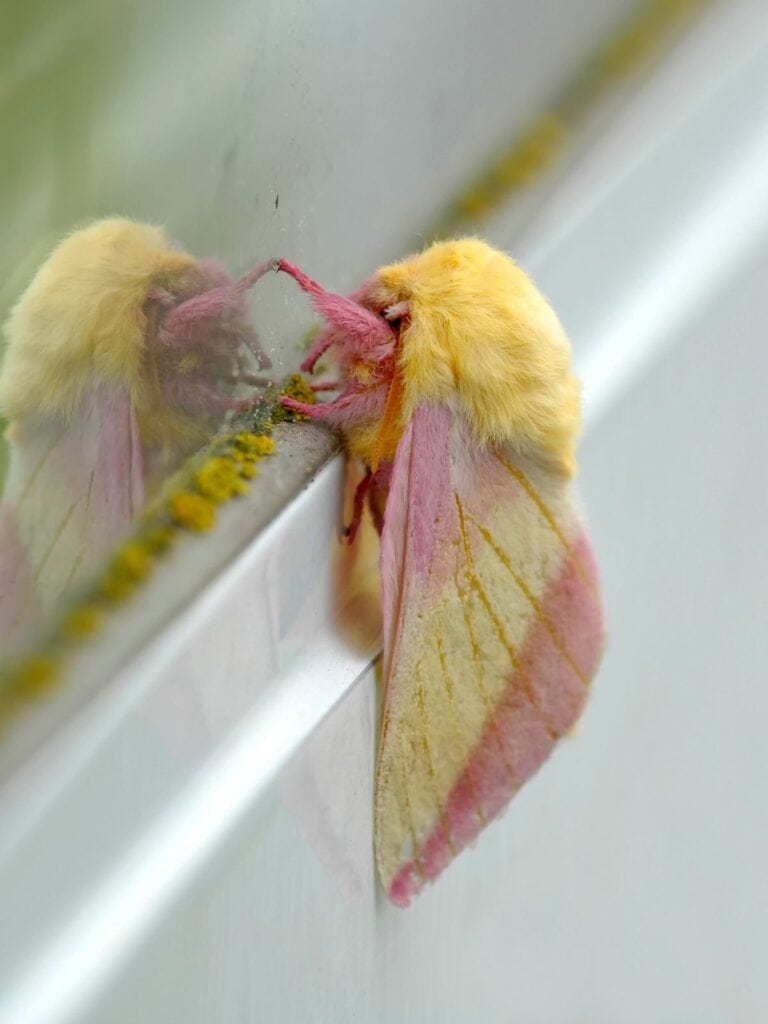
The rosy maple moth looks like cotton candy brought to life, with soft, fuzzy bodies covered in bright pink and yellow fur.
These stunning insects are one of the smallest silk moths in North America.
Despite their vibrant coloring, rosy maple moths only live for about a week as adults.
During this brief time, they focus entirely on reproduction and don’t eat at all.
Their coloration may serve as a warning to predators, as the bright colors suggest they might be toxic, even though they’re actually harmless.
This would make it an example of Batesian mimicry.
As caterpillars, they’re green and white striped, feeding mainly on maple leaves.
They’re considered minor pests in maple tree populations but rarely cause significant damage.
These moths are most active at night and are attracted to lights, often showing up on porches throughout their range in eastern North America.
Their soft, woolly appearance has made them popular subjects for insect photography.
46. Secretary Bird
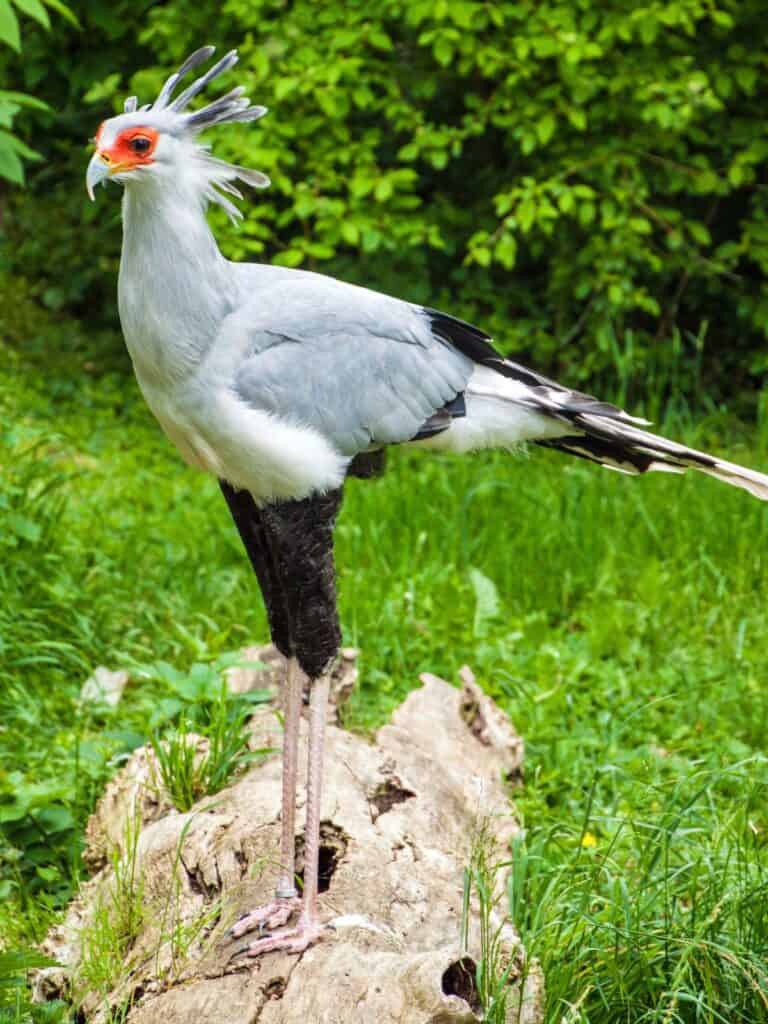
The secretary bird looks like someone tried to create an eagle but accidentally gave it the legs of a crane and a punk rock crest 🤘
Funny as it looks, these massive birds are no joke, and some would call them downright scary birds.
Standing nearly 4-feet-tall (1.2 m), this African raptor is one of the most distinctive birds of prey.
These birds hunt by stomping their prey to death, delivering powerful kicks that can kill snakes, including venomous ones.
They can stomp five times in the blink of an eye with a force up to five times their body weight.
Secretary birds have exceptionally long eyelashes that protect their eyes while they’re battling with snakes and other dangerous prey.
They’re one of the few birds that hunt primarily on foot rather than from the air.
Their name may come from their quill-like head feathers, which resemble the quill pens 18th-century clerks tucked behind their ears.
They also build their nests in treetops, even though they hunt on the ground.
Found across African savannas, secretary birds mate for life and can live up to 15 years in the wild.
They’re listed as endangered due to habitat loss and degradation.
47. Sichuan Takin

The Sichuan takin looks like nature couldn’t decide between creating a goat, an antelope, a musk ox, and a bear — so it put all four into one animal to make the ultimate hybrid.
Takins may have been the inspiration for the Golden Fleece in Greek mythology, as they were known along ancient trade routes between Europe and Asia.
Also known as the golden takin, these stocky, golden-furred ungulates have a bulbous nose, thick legs, and a shaggy coat.
Their thick, oily coat helps repel rain in the misty mountain forests they inhabit.
Sichuan takins can weigh up to 770 pounds (350 kg) and stand more than three-feet-tall (0.9 m) at the shoulder.
These herbivores live in herds in the mountains of central China and eastern Tibet, migrating to higher elevations in summer and lower in winter.
They’re excellent climbers and can navigate steep, rocky terrain with ease.
Takins are territorial and can be aggressive, using their horns and bulk to defend their territory.
They’re listed as vulnerable due to habitat loss and hunting, though populations are slowly recovering thanks to conservation efforts.
48. Tufted Deer

The tufted deer looks like a vampire cosplaying as Bambi, with prominent fang-like canine teeth and a dramatic tuft of black hair on its forehead.
These small deer are native to central China and northeastern Myanmar.
Males have long, sharp canines that protrude below the lip and can grow up to one-inch-long (2.5 cm).
They use these vampire fangs for fighting with other males during mating season.
The distinctive black tuft of hair between their ears can be raised when the deer is alarmed or excited, making them look even more dramatic.
This tuft feature gives them their name.
Tufted deer are solitary and extremely shy, preferring dense forest undergrowth where they can hide from predators.
They’re most active at dawn and dusk, feeding on leaves, grass, and fruit.
These unusual deer communicate using scent glands on their faces and feet.
They also make loud barking sounds when alarmed.
Climate change and habitat loss pose threats to their populations.
49. Vampire Ground Finch
The vampire ground finch is exactly what it sounds like: A small bird from the Galápagos Islands that drinks the blood of other birds.
This shocking behavior makes it one of nature’s most unexpected bloodsuckers 🧛🏻♂️
These finches peck at the base of seabird wings until blood flows, then lap it up like a tiny feathered vampire.
They primarily target boobies and other large seabirds that are too docile to fight back effectively.
This vampiric behavior likely evolved during periods of drought when the finches’ usual food sources like seeds and insects became scarce.
The blood-sucking behavior has since become a regular part of their diet.
Despite their bloodthirsty habits, vampire ground finches also eat seeds, eggs, and even baby seabird feces (which contains undigested nutrients).
They’re opportunistic feeders that will eat almost anything.
Found only on Wolf and Darwin Islands in the Galápagos, these birds are one of Darwin’s famous finches, and an example of adaptive evolution.
Climate change threatens their already limited habitat.
50. Vinegaroon (Whip Scorpion)
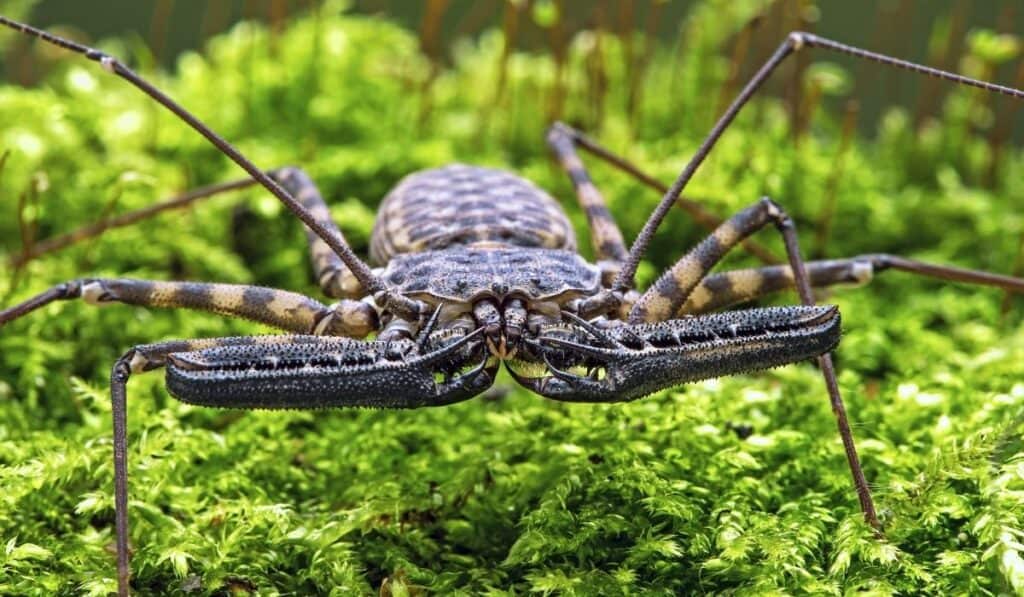
The vinegaroon is a nightmarish arachnid that looks like a scorpion and a spider had a baby.
Also called a whip scorpion, it has huge crushing pincers and a long whip-like tail, but no venomous stinger.
When threatened, vinegaroons spray acetic acid (the main component of vinegar) from glands at the base of their tail.
This spray can be aimed with surprising accuracy and creates a strong vinegar smell.
These large arachnids can grow up to 3 inches long (7.5 cm) — not counting their whip-tail, which can be up to another 3 inches long (7.5 cm)!
Nearly blind, they use their first pair of legs as sensory organs, feeling their way through the dark.
Vinegaroons are ambush predators, waiting patiently for insects, millipedes, and other small prey to wander close enough to grab with their powerful pedipalps.
They crush their prey before eating it.
Found in the southwestern United States, Mexico, and parts of South America, vinegaroons are beneficial to humans as they eat cockroaches and other pests.
Despite their fearsome appearance, they’re harmless to people.
51. Bald Uakari
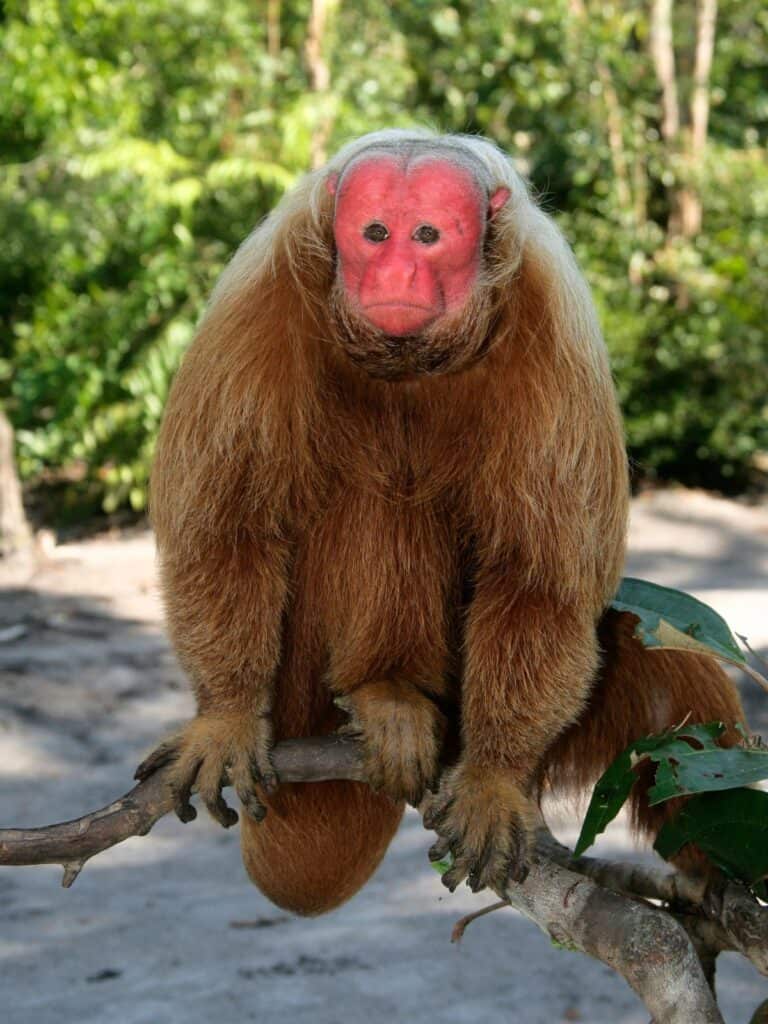
The bald uakari monkey has a bright red, hairless face that looks like it’s perpetually sunburned or embarrassed.
This striking coloration makes it one of the most distinctive primates in the Amazon.
Nature’s version of a health indicator, the redder the face, the healthier the monkey.
Pale faces indicate illness or parasites, so the vibrant red is a sign of fitness and attractiveness to potential mates.
These monkeys have extremely short tails for New World primates, giving them a stocky appearance.
They live in the flooded rainforests of the Amazon basin, particularly in Brazil and Peru.
Uakaris spend most of their lives high in the trees of the flooded forest, rarely coming down to the ground.
They live in large troops of up to 100 individuals, though they usually forage in smaller groups.
Their shaggy reddish-brown fur contrasts dramatically with their bald red faces.
Uakaris feed mainly on seeds, which they can crack open with their powerful jaws.
Habitat loss and hunting threaten their populations.
52. Barreleye Fish

The barreleye fish has a completely transparent head with tubular eyes that point upward inside its fluid-filled dome.
Looking at one is like seeing a fish with a glass head that reveals its brain and optic nerves.
These deep-sea fish can rotate their eyes from looking upward to looking forward.
Scientists only discovered this ability in 2009, and it allows them to search for prey above and then switch to forward vision when attacking.
The transparent shield over the fish’s head is filled with clear fluid, protecting the sensitive eyes while maintaining visibility in all directions.
The fish’s eyes are extremely sensitive to light.
Barreleye fish live at depths of 2,000-2,600 feet (600-800 m) and are rarely observed.
They’re thought to steal food from siphonophores, positioning themselves to intercept prey caught in the siphonophore’s tentacles.
The “eyes” that appear to be at the front of the fish are actually its nostrils.
The real eyes are the green glowing orbs visible inside the transparent head.
53. Bat-Eared Fox
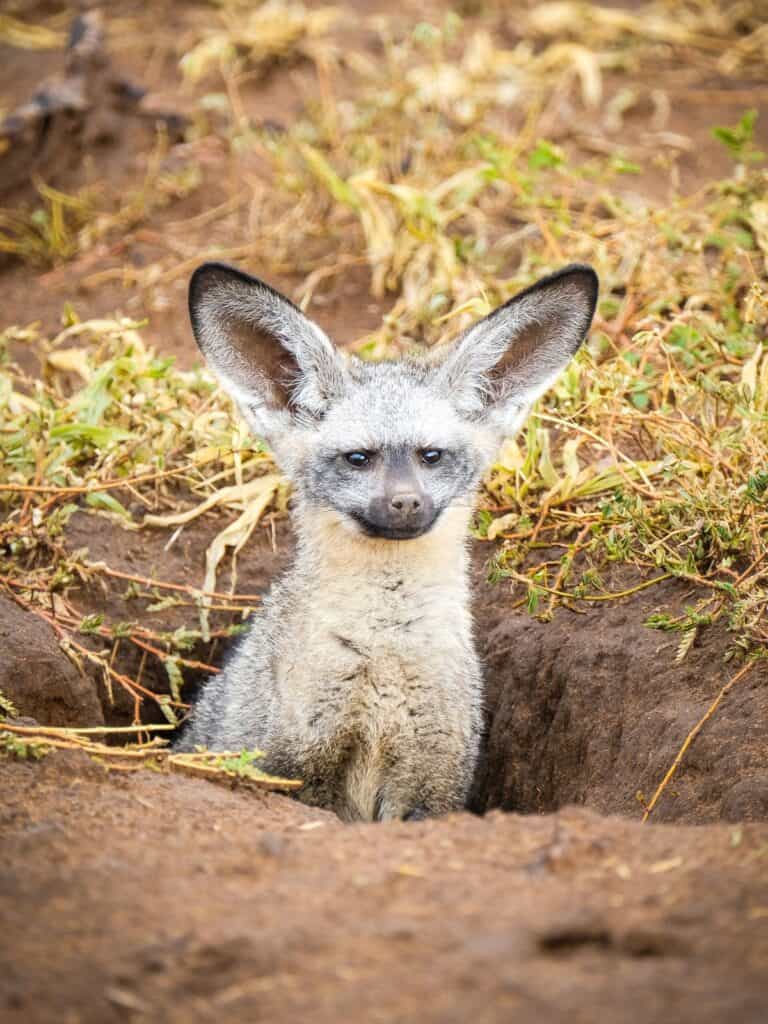
The bat-eared fox looks like someone photoshopped a fox’s head onto massive satellite dishes.
These small African canids have absolutely enormous ears of up to 5-inches-tall (12.7 cm), which dominate their fox-like faces.
Their ears can detect the movement of termites underground, allowing them to locate and dig up their favorite prey.
A single bat-eared fox can eat more than 1 million termites per year.
Unlike most canids, bat-eared foxes have extra molars for chewing insects.
They’re primarily insectivores, with termites making up 80% of their diet, though they’ll also eat beetles, locusts, and grasshoppers.
These social animals live in pairs or small family groups and mate for life.
They’re one of the few canid species where males contribute significantly to raising offspring, guarding pups while mothers forage.
Found in the savannas and semi-arid areas of eastern and southern Africa, bat-eared foxes are nocturnal during hot months but may be active during the day in cooler periods.
They’re not currently threatened.
54. Blue-Tongued Skink
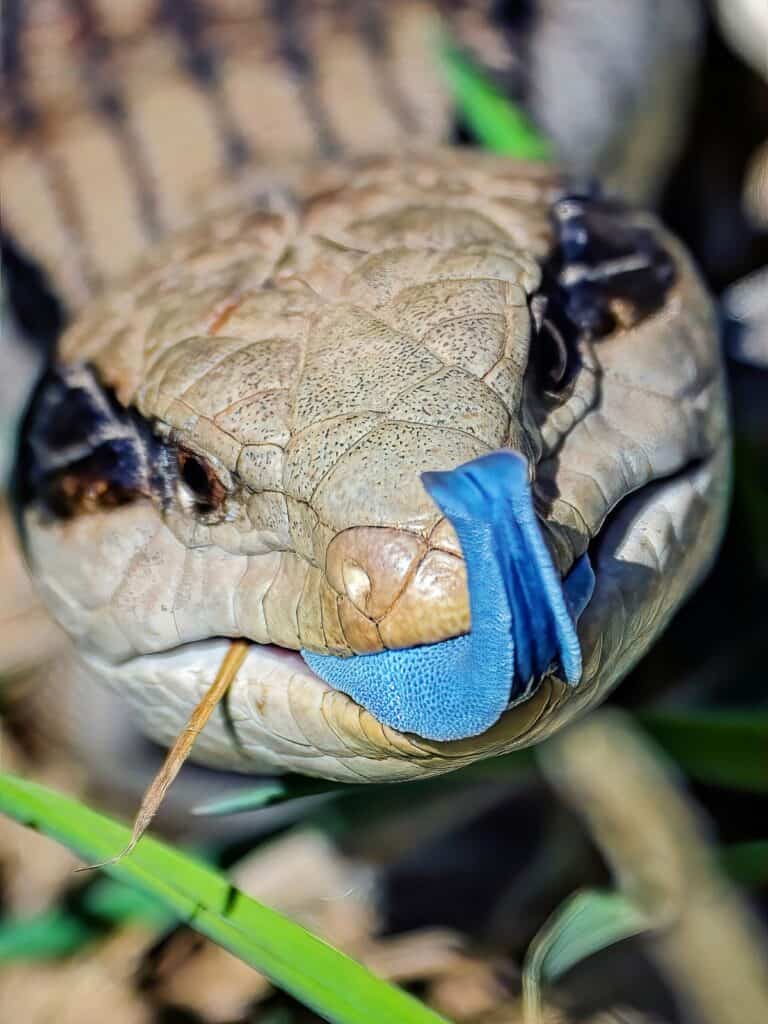
The blue-tongued skink is a chunky lizard with a tongue so intensely blue it looks like it’s been eating blue raspberry candy.
These Australian reptiles use their vibrant tongues as a defense mechanism.
When threatened, they open their pink mouths wide and stick out their bright blue tongues, creating a startling contrast that confuses and deters predators.
The sudden flash of color is enough to make most animals think twice.
Similar to bearded dragons, these docile lizards are surprisingly friendly and make popular pets due to their calm temperament.
They’re ground-dwelling and prefer to walk rather than climb, with short legs and heavy bodies.
Blue-tongued skinks give live birth to babies rather than laying eggs, unusual for reptiles.
Females can have up to 25 babies at once, though 10-15 is more typical.
Found throughout Australia and parts of Indonesia, these omnivores eat snails, flowers, fruits, and berries.
They can live up to 20 years in captivity and have become increasingly popular in the exotic pet trade.
55. Bobbit Worm
The bobbit worm aka sand-striker is a nightmare-inducing predator that burrows in the seafloor and ambushes prey with lightning-fast strikes.
These bristle worms can grow more than 10-feet-long (3 m), though most of their body remains hidden.
They sense prey with their five antennae, then strike upward with razor-sharp mandibles that can slice fish in half.
The attack happens in just 0.01 seconds, which is faster than humans can blink 👀
Bobbit worms inject prey with toxins that stun or kill them instantly. They then drag the victim into their burrows to consume at leisure.
Their attacks are so violent they sometimes catch multiple fish at once.
Named after Lorena Bobbitt (because they can sever body parts), these worms have been known to damage coral reefs and terrorize home aquariums where they sometimes arrive as stowaways.
Found in warmer ocean waters worldwide, bobbit worms are nocturnal hunters that can live for years in their burrows.
Divers rarely see them, but when they do, it’s usually just the worm’s iridescent bristles.
56. Colossal Squid
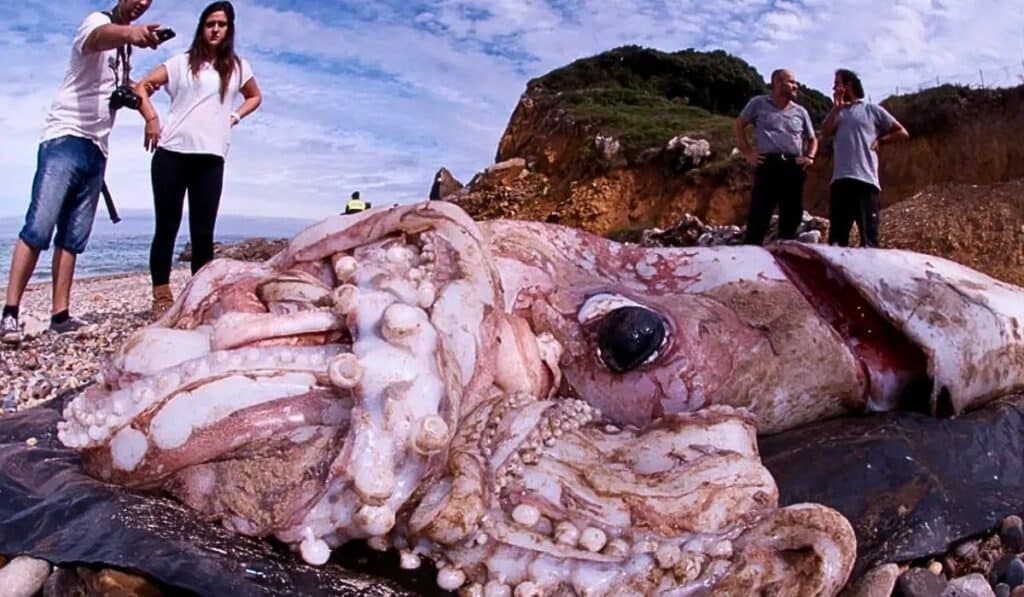
The colossal squid is the heaviest squid species on Earth, with the largest specimen ever caught weighing 1,091 pounds (495 kg).
These massive cephalopods have the largest eyes of any living creature, which are up to 10 inches (25.5 cm) in diameter.
Their tentacles are armed with rotating hooks in addition to suckers, making them formidable predators of the deep ocean.
These hooks can rotate 360° and are used to snag prey.
Colossal squid live in the deep waters around Antarctica, hunting fish and other squid in near-freezing temperatures and total darkness.
Very few have ever been seen alive, and the first footage of a live colossal squid in the wild wasn’t captured until 2025.
These giants have bioluminescent organs on their body and eyes, possibly used to stun prey or communicate with other squid.
They have a relatively slow metabolism adapted for deep, cold water.
Sperm whales are their main predators, and circular scars on whales’ skin show evidence of fierce battles with colossal squid.
Scientists estimate these squid can live in waters as deep as 7,200 feet (2,200 m).
57. Dementor Wasp
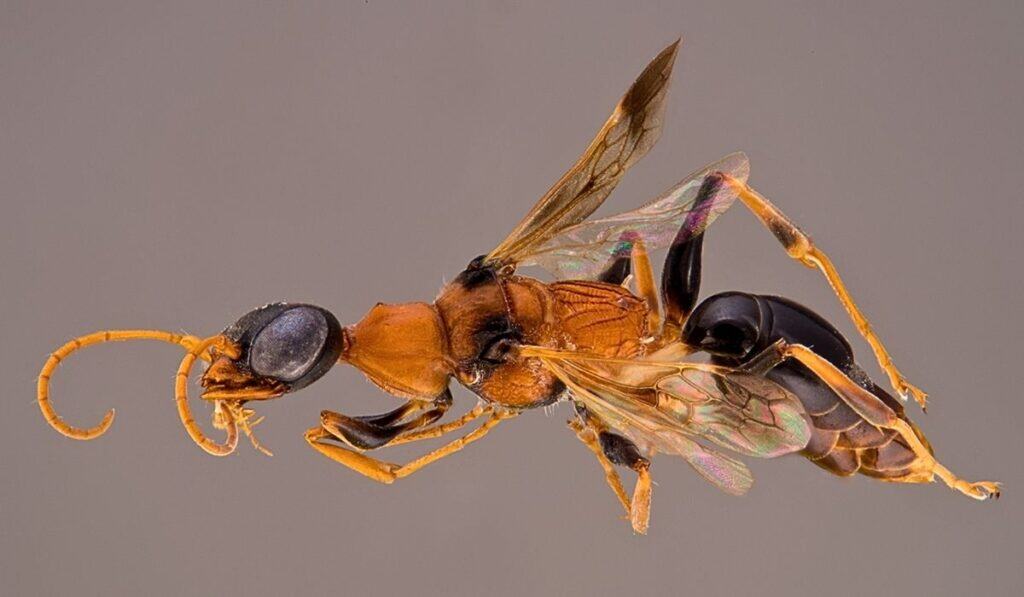
The dementor wasp, named after the soul-sucking creatures from Harry Potter, turns cockroaches into zombies by injecting venom directly into their brains.
This parasitic wasp from Thailand has one of nature’s most sinister hunting strategies.
The venom blocks specific neurotransmitters, leaving the cockroach alive but completely docile so it becomes a living zombie 🧟
It can then be led around by its antennae like a dog on a leash.
The wasp leads its zombie roach to a safe location, lays an egg on its leg, then seals it in a burrow.
The cockroach remains alive and fresh while the wasp larva slowly consumes it from the inside.
Scientists named the wasp Ampulex dementor (dementor wasp) after a public vote in 2014.
It’s one of more than 170 species of cockroach wasps, all of which have variations on this gruesome reproductive strategy.
Found in Southeast Asia, dementor wasps are actually beneficial to humans as they help control cockroach populations.
Each female wasp can zombify dozens of cockroaches during her lifetime.
58. Dragon-Headed Caterpillar

Dragon-headed caterpillars look like tiny Asian dragons with elaborate horned “helmets” on their heads.
These structures, called head capsules, make the caterpillars appear much larger and more threatening than they actually are.
The dragon-like appearance is purely defensive, as the elaborate horns and intimidating face markings frighten birds and other predators into leaving them alone.
Despite looking fierce, these caterpillars are completely harmless.
Dragon caterpillars are actually quite common but often overlooked due to their excellent camouflage when not displaying their dragon heads 🐲
Despite the name, they aren’t moths, but the caterpillars of nawab and rajah butterflies.
The “horns” vary dramatically between species, with some looking like multi-pronged antlers and others resembling curved demon horns.
When threatened, the caterpillar rears up to display its impressive headgear.
Found in tropical Africa, Asia, and Australia, dragon-headed caterpillars transform into fast-flying butterflies as adults.
Their larval stage dragon costume is purely for survival.
59. Dugong

The dugong is a large marine mammal often called a sea cow, with a rotund body, paddle-like flippers, and a tail fluke like a whale’s.
These gentle giants are the only strictly marine herbivorous mammals.
Dugongs spend their days grazing on seagrass, using their downturned snout to root around on the seafloor like underwater vacuum cleaners.
A single dugong can eat up to 88 pounds (40 kg) of seagrass per day.
These slow-moving animals can hold their breath for up to six minutes while feeding but typically surface every one to three minutes to breathe.
They’re surprisingly social, sometimes gathering in herds of hundreds.
Ancient sailors mistook dugongs for mermaids, giving rise to numerous legends and folktales.
With their large size and distant relationship to elephants, they’re often associated with mythology and folklore.
Found in warm coastal waters from East Africa to Australia, dugongs are vulnerable to extinction.
Boat strikes, fishing net entanglement, and habitat loss from seagrass degradation threaten their populations.
60. Flying Snake
Flying snakes don’t actually fly; they glide through the air with incredible precision by flattening their bodies and undulating through the air.
These Southeast Asian reptiles can “fly” up to 330-feet (100 m) between trees.
They’re better gliders than flying squirrels 🐿️ able to maneuver in mid-air by moving their bodies in an S-shape.
This allows them to change direction and even make turns while airborne.
To take flight, a flying snake launches itself from a branch, flattens its body to nearly twice its normal width, and undulates through the air.
The flattened shape acts like a wing, providing lift.
There are five species of flying snakes, all mildly venomous but harmless to humans.
They primarily hunt lizards and frogs in the rainforest canopy and rarely descend to the ground.
Flying snakes are surprisingly good at calculating distances and angles before launching.
They seem to understand physics at an instinctive level, adjusting their launch position and trajectory for maximum distance.
61. Egg-Eating Snake

Egg-eating snakes have evolved to survive exclusively on bird eggs.
These slender snakes are nature’s ultimate egg thieves with highly specialized anatomy that allows them to swallow eggs twice the diameter of their heads.
Surprisingly, they have virtually no teeth 🦷
Instead, they have bony projections in their throat that crack open eggs after swallowing them whole.
The snake then regurgitates the crushed shell while keeping the nutritious contents.
When threatened, egg-eating snakes mimic venomous vipers by coiling their bodies, flattening their heads, and rubbing their scales together to produce a hissing sound.
This is pure bluff, as they’re completely harmless.
These snakes have incredibly flexible jaws and elastic skin that allows them to accommodate massive eggs.
The process of swallowing an egg can take 30 minutes or more.
Found throughout Africa, egg-eating snakes face challenges during months when birds aren’t nesting.
They can survive long periods without food by drastically slowing their metabolism.
62. Fried Egg Jellyfish
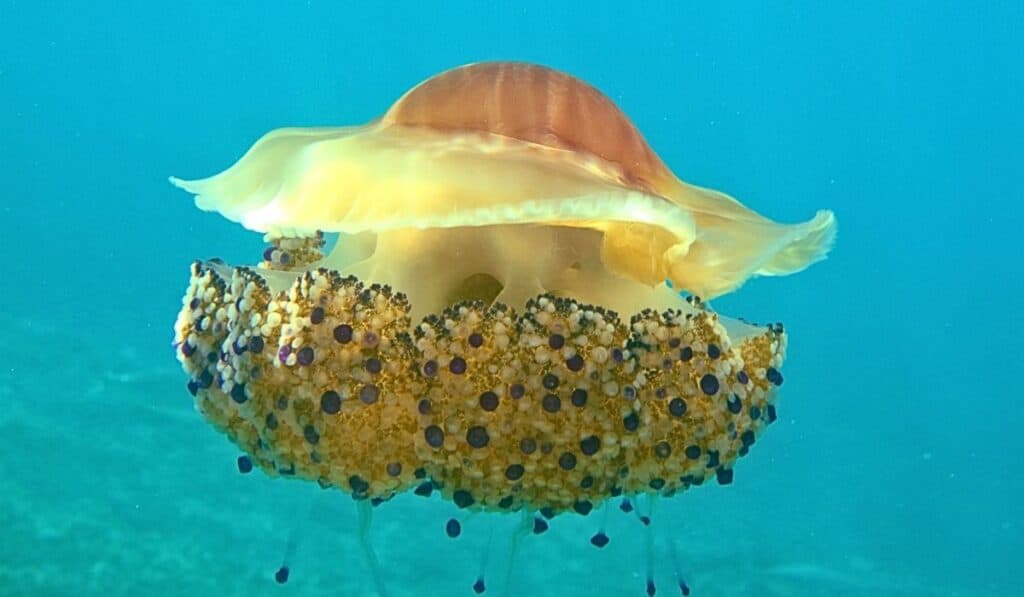
The fried egg jellyfish looks exactly like its name suggests: A sunny-side-up egg floating through the ocean 🍳
These distinctive jellyfish have a bright yellow dome surrounded by a translucent white bell.
Two species share this common name: the Mediterranean fried egg jellyfish and the egg-yolk jellyfish from the Pacific.
Both have the characteristic appearance, but are only distantly related.
Despite their gentle appearance, these jellyfish have mild stinging cells on their tentacles used to capture small fish and zooplankton.
Their sting is harmless to humans, but can irritate sensitive skin.
Fried egg jellyfish can grow quite large, with bells reaching 2-feet (60 cm) in diameter, with tentacles extending several feet.
They drift with ocean currents, unable to swim against them.
Small crabs and juvenile fish sometimes shelter beneath the jellyfish’s bell, gaining protection from predators while feeding on the jellyfish’s parasites and leftover prey.
63. Fangtooth Fish
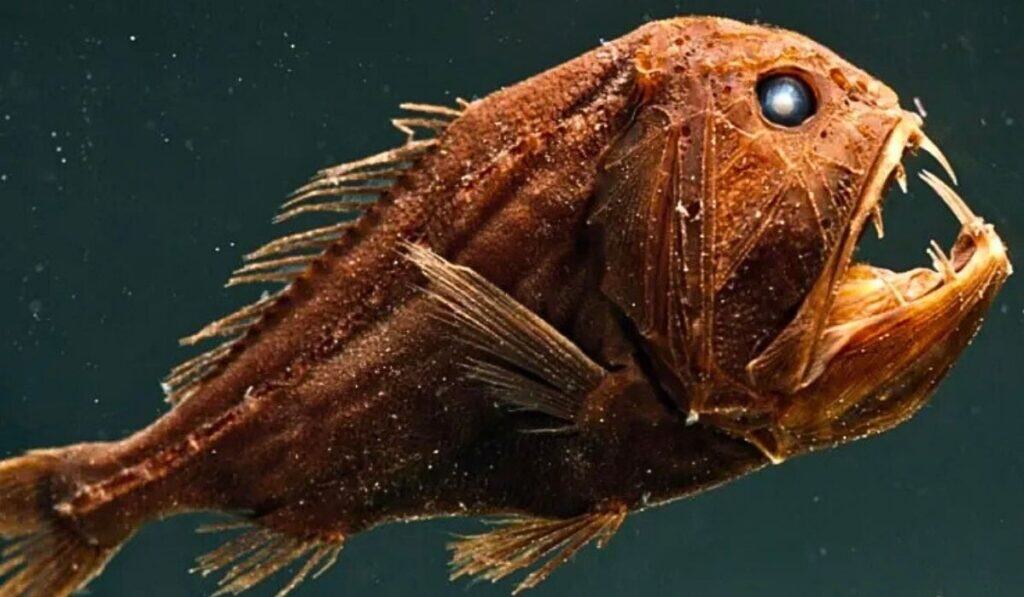
The fangtooth fish has the largest teeth proportional to body size of any fish in the ocean 🦷
These deep-sea monsters look like something from a horror movie, with massive needle-like teeth that don’t fit inside their mouths.
The teeth are so large that the fangtooth has evolved special sockets on either side of its brain to accommodate the upper fangs when its mouth closes.
The lower fangs slide into these pockets when the mouth shuts.
Living as deep as 16,000-feet (5,000 m), fangtooth fish endure crushing pressure and near-freezing temperatures in complete darkness.
As you might imagine, they’re rarely seen by humans.
Despite their terrifying appearance, fangtooth fish only grow to about 6-inches-long (16 cm).
Their large teeth help them grab and hold any prey they encounter in the food-scarce deep ocean.
Juvenile fangtooth look completely different from adults, with gray coloring and long spines.
As they mature, they descend deeper and develop their characteristic menacing teeth and dark coloration.
64. Vampire Squid
Despite its terrifying name, the vampire squid is actually a gentle creature.
It feeds on marine snow (aka ocean dandruff), like dead plankton, feces, and other organic debris that drifts down from surface waters.
This deep-sea cephalopod can turn itself inside-out, folding its arms over its body like a cloak lined with fleshy spines.
This defensive posture, combined with its dark coloring, gave it the “vampire” name.
The vampire squid has the largest eyes relative to body size of any animal on Earth.
These enormous blue eyes, up to an inch in diameter, help it see in the near-total darkness of the deep ocean.
It can produce bioluminescent flashes from light organs at the tips of its arms, potentially confusing predators.
Vampire squid also shoot glowing mucus instead of ink when threatened.
Living at depths of 2,000- to 3,000-feet-deep (600-900 m), they inhabit oxygen minimum zones that most predators can’t tolerate.
They have a slow metabolism and can survive on very little oxygen.
65. Long-Wattled Umbrellabird
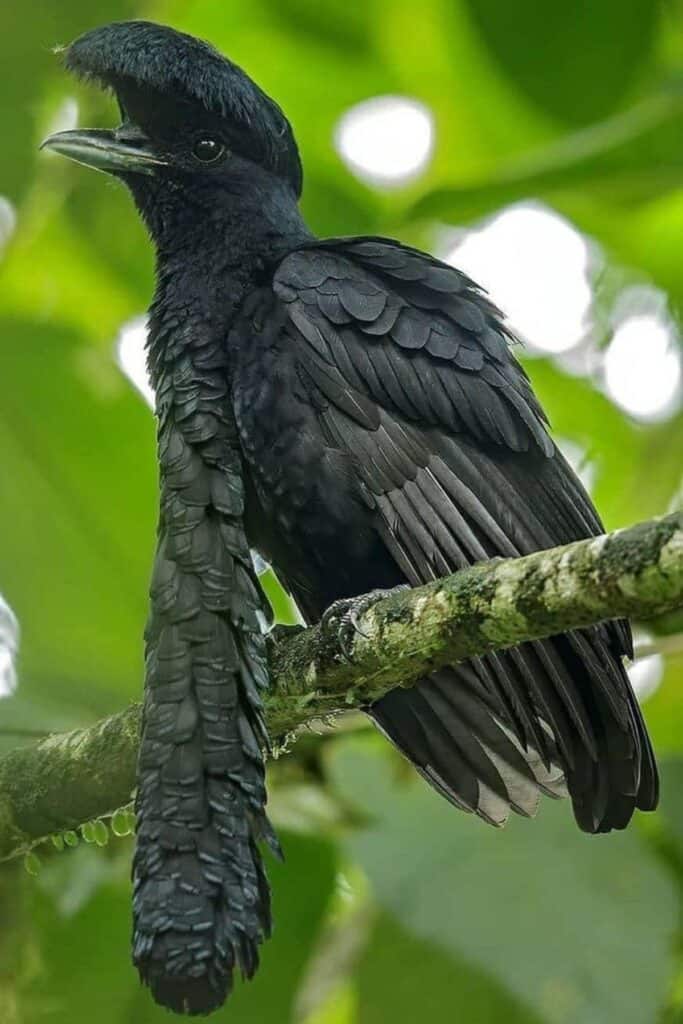
The long-wattled umbrellabird is one of the most bizarre birds in South America.
Males have wattles that can hang up to 14 inches long (35 cm), one of the most unusual ornaments in the bird world.
This feathered wattle dangles from their chest like a bizarre necktie, while a bushy crest fans out over their heads like an umbrella.
During courtship displays, they inflate this wattle while making deep, booming calls that echo through the rainforest.
These large black birds use an air sac in their throat to amplify their mating calls.
The crest can be raised or lowered depending on the bird’s mood, creating a dramatic silhouette against the forest canopy.
Long-wattled umbrellabirds are fruit specialists, feeding primarily on palm fruits and playing important roles in seed dispersal.
They regurgitate large seeds after digesting the fruit pulp, helping regenerate the forest.
Found only in the humid forests of western Colombia and Ecuador, these spectacular birds are vulnerable due to habitat loss from logging and mining.
Males gather at group mating sites called leks to perform for females.
66. Gharial

The gharial is a unique crocodilian with an extremely long, narrow snout filled with more than 100 sharp, interlocking teeth 🦷
This bizarre appearance makes it one of the most distinctive reptiles on Earth.
Male gharials develop a bulbous growth on the end of their snout called a ghara (which means “pot” in Hindi).
This is used to make buzzing sounds and blow bubbles during courtship displays.
Their narrow snout is perfectly adapted for catching fish, as it can be whipped sideways through water with minimal resistance.
The gharial’s teeth are ideal for gripping slippery fish, but useless for crushing.
These massive reptiles can grow more than 20-feet-long (6 m) but are completely harmless to humans.
Their specialized diet and weak legs make them ineffective on land.
Critically endangered, gharials inhabit rivers in India and Nepal.
Only about 650 adults remain in the wild due to habitat loss, fishing net entanglement, and sand mining destroying their nesting sites.
67. Ghost Shark
Ghost sharks aren’t actually sharks but relatives called chimaeras, ancient fish that split from sharks 400 million years ago 🦈
These deep-sea dwellers have cartilage instead of bone and look like pale, ghostly apparitions.
Ghost sharks have the slowest-evolving genome of any vertebrate animal, remaining virtually unchanged for hundreds of millions of years.
They’re living fossils in the truest sense.
Their snouts are covered with sensory pores that detect electrical signals from prey buried in sediment.
Some species have a retractable reproductive organ on their forehead, adding to their bizarre appearance.
Ghost sharks lay eggs in leathery cases that can take more than a year to hatch.
The eggs are sometimes found washed up on beaches, called “mermaid’s purses.”
Living at depths up to 8,200 feet (2,500 m), ghost sharks are rarely seen by humans — so check out the video above to see one of these rarely filmed fish.
They have large eyes adapted for low light and can appear silvery or pale in color, giving them their ethereal name.
68. Hammer-Headed Bat
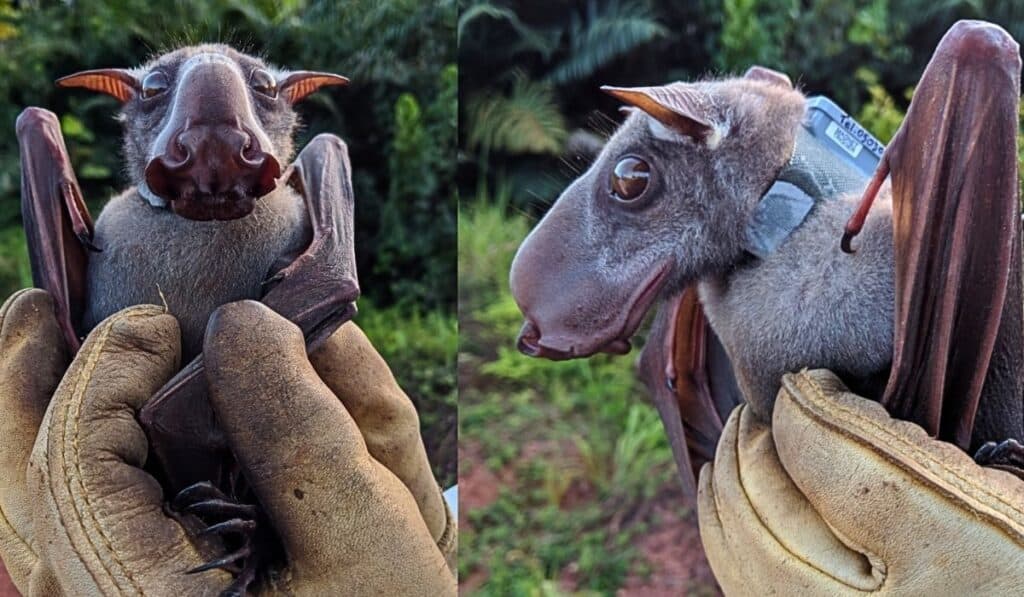
The hammer-headed bat is the largest bat in mainland Africa, with males having massive, bizarre square-shaped heads that look like they were designed with a mallet.
These megabats can have wingspans of more than 3-feet (1 m).
The enlarged head is an echo chamber that amplifies males’ honking mating calls.
Males gather in mating groups called leks, competing to produce the loudest and most attractive calls to females.
Only males have the distinctive hammer-shaped head; females have more normal, fox-like faces.
Males also have large larynxes that take up most of their chest cavity, leaving little room for other organs.
These fruit bats can fly 20-30 miles (32-48 km) per night searching for ripe fruit 🍌
They play crucial roles in seed dispersal and pollination across African rainforests.
Found in equatorial Africa, hammer-headed bats roost alone during the day in trees.
Local folklore sometimes associates them with witchcraft, but they’re completely harmless to humans.
69. Helmeted Hornbill

The helmeted hornbill has a solid casque made of keratin on top of its bill, making it the only bird in the world with a solid casque (helmet).
This hard structure makes up 10% of the bird’s total weight.
Males use their helmeted bills as battering rams, engaging in dramatic aerial jousting matches where they crash into each other mid-flight.
These battles can last more than an hour.
The casque is bright yellow-orange and is called “red ivory” by poachers.
It’s been carved for centuries in Asia, putting these magnificent birds at severe risk. They’re now critically endangered.
Helmeted hornbills have an incredible call that starts with a few slow hoots and accelerates into maniacal laughter.
This call can carry for half a mile through dense rainforest.
Found in Southeast Asian rainforests, these birds nest in tree cavities where females seal themselves in with mud, leaving only a small opening.
Males feed the female and chicks for months until they emerge.
70. Honduran White Bat

The Honduran white bat is one of the world’s tiniest bats, with fluffy white fur and bright yellow ears and nose leaf.
These adorable creatures look like tiny cotton balls with faces.
They construct “tents” by chewing through the veins of heliconia leaves, causing the leaves to fold down and create a protective shelter.
Several bats roost together under these living umbrellas.
These bats are so small they weigh about as much as two pennies, or only about 0.2 ounces (5-6 grams).
Despite their size, they’re excellent fliers, hunting insects at night.
The yellow coloring on their nose and ears is thought to help them locate each other in the dark understory.
When light filters through the green leaf tent, the bats’ white fur appears greenish, providing camouflage.
Found in Central America, particularly Honduras, Nicaragua, and Costa Rica, these bats face threats from deforestation.
They depend on intact rainforest with large heliconia plants for survival.
71. Irrawaddy Dolphin
The Irrawaddy dolphin has a rounded head, no beak, and a shy smile that makes it look perpetually pleased.
These dolphins are famous for spitting water, and they use this to herd fish into tight groups.
Unlike most dolphins, they can bend their necks up to 90°.
This flexibility helps them navigate shallow, murky rivers and coastal waters where they hunt.
Irrawaddy dolphins are known to cooperatively fish with humans in Myanmar and parts of Southeast Asia.
They drive fish into fishing nets in exchange for a share of the catch; a behavior passed down through generations.
These dolphins communicate using clicks, buzzes, and creaks.
They’re social animals, usually traveling in groups of 3-6 individuals, though larger groups sometimes gather.
Critically endangered in parts of their range, Irrawaddy dolphins face threats from fishing nets, habitat degradation, and boat strikes.
The Mekong River population is particularly vulnerable, with only around 100 individuals remaining 😢
72. Jabiru

The jabiru is the tallest flying bird in South and Central America, standing up to 5-feet-tall (1.5 meters) with a wingspan more than 9-feet (2.75 m).
Their huge black bill, bald black head, and white plumage give them a prehistoric appearance.
Their name comes from a Tupi-Guarani word meaning “swollen neck,” referring to the distinctive red collar at the base of their neck that becomes more inflated during breeding season.
Jabirus are apex predators in wetland ecosystems, eating fish, frogs, snakes, insects, and even young caimans.
They wade through shallow water, jabbing their massive bills to catch prey.
These powerful fliers can soar for hours on thermal air currents, their necks extended and legs trailing behind.
They build massive stick nests in tall trees, sometimes reusing and expanding them for years.
Found from Mexico to Argentina, jabirus prefer large wetlands and river systems.
They’re not globally threatened but face local declines due to wetland drainage and habitat loss.
73. Lesula

The lesula monkey was first spotted by scientists in 2007 and only officially described in 2012, making it one of the most recently discovered primates.
Their human-like eyes are unusually large and expressive, giving them an almost eerie appearance.
These shy monkeys have strikingly human-like faces that have been compared to actors Jake Gyllenhaal and David Schwimmer.
Adult lesulas have a distinctive blond mane and striped legs.
Found only in the remote rainforests of the Democratic Republic of Congo’s Lomami Basin, lesulas live in small family groups.
They feed on fruits, leaves, and flowers in the forest canopy.
Local people had known about lesulas for generations, and scientists first spotted one being kept as a pet in a village.
After years of study, they confirmed it as a brand-new species.
Threatened by bushmeat hunting and habitat loss, lesulas face an uncertain future.
Their limited range makes them especially vulnerable to deforestation and human encroachment.
74. Ocean Sunfish (Mola Mola)
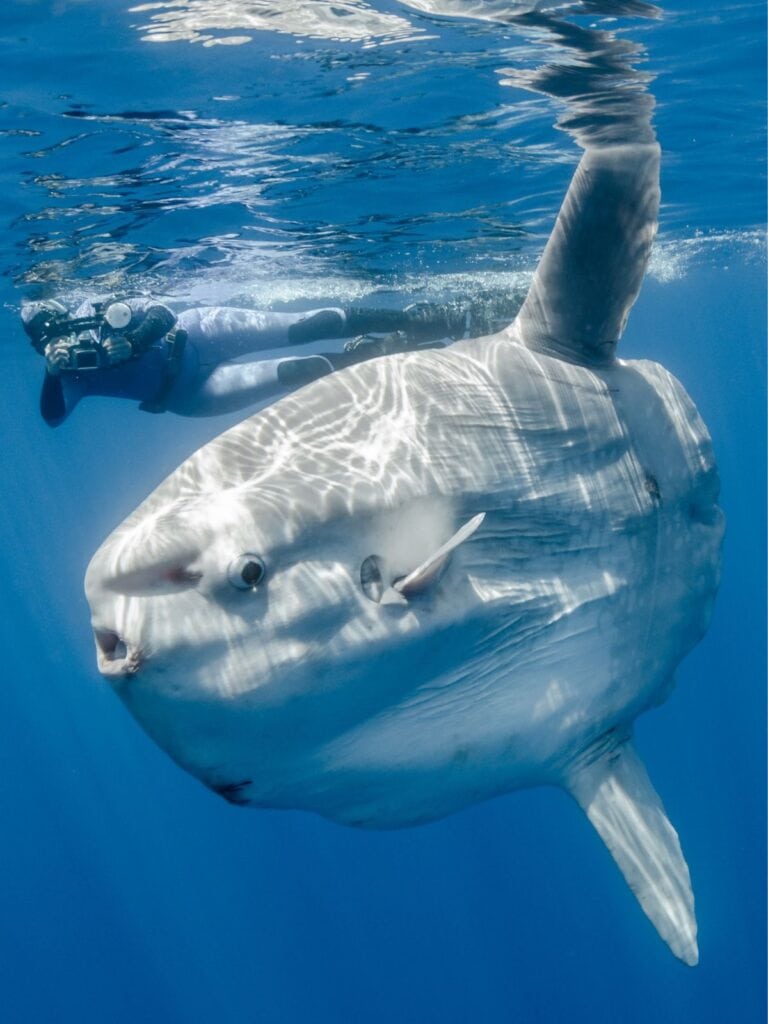
The ocean sunfish, or mola mola, looks like someone started making a fish and gave up halfway through.
These bizarre creatures appear to be just a giant head with fins, as if their back half was bitten off by a shark.
They’re the heaviest bony fish in the world, weighing up to 5,000 pounds (2,300 kg) and measuring 10 feet (3 m) across.
Despite their enormous size, they start life as tiny larvae smaller than a pinhead.
Ocean sunfish have a peculiar habit of basking on their sides at the ocean surface, which is how they got their name.
Scientists believe they do this to allow seabirds to eat parasites off their skin and to warm up after deep dives.
These gentle giants can dive more than 2,600 feet deep (800 meters) but spend much of their time near the surface eating jellyfish.
They need to consume huge amounts of their low-calorie prey, sometimes eating up to 70 jellyfish in a single day.
Mola molas produce more eggs than any other vertebrate; up to 300 million at once.
They’re found in temperate and tropical oceans worldwide, though they’re often mistaken for sharks when their dorsal fins break the surface.
75. Maned Wolf

The maned wolf looks like someone stretched a fox onto impossibly long stilts.
With legs making up half its body height, this South American canid has a unique, elegant appearance unlike any other wild dog.
Despite its name and appearance, it’s neither a wolf nor a fox.
In fact, it’s the only species in its genus and isn’t closely related to any other living canid. Its scientific name, Chrysocyon, means “golden dog.”
Maned wolves are omnivores with a diet unusual for canids, as up to 50% of their diet consists of plants, particularly a tomato-like fruit called lobeira (wolf fruit).
They also eat small mammals, birds, and insects.
These solitary animals have a distinctive scent, and famously, their pee often smells like marijuana (or skunk 🦨).
Zookeepers have been visited by police investigating this unusual odor from maned wolf enclosures!
Found in grasslands and scrub forests of Brazil, Paraguay, Bolivia, and Argentina, maned wolves face habitat loss as their grassland homes are converted to agriculture.
They’re listed as near threatened.
76. Marabou Stork

The marabou stork is one of the largest storks in the world and has been called “the undertaker bird” due to its dark cloak-like wings and bald head.
These scavengers have an ominous, vulture-like appearance 🪦
At up to 12-feet (3.6 meters), they have the largest wingspan of any stork.
This allows them to soar for hours while scanning for food below.
Marabou storks have a throat pouch that can inflate up to a massive 18-inches-long (45.5 cm), which is used for display and possibly thermoregulation.
They also urinate on their legs to cool down, giving them white-stained “stockings.”
These aggressive birds are known to kill and eat flamingos, pelicans, and other large birds.
They’ll also scavenge at landfills and steal food from other predators.
Found across sub-Saharan Africa, marabou storks thrive near human habitation, feeding on garbage and taking advantage of human-modified landscapes.
Their populations are stable despite their menacing reputation.
77. Markhor Goat

The markhor is a large wild goat with magnificent corkscrew-shaped horns that can grow more than 5-feet-long (1.5 m).
These impressive spirals twist like nature’s version of a twisted unicorn horn.
Their name means “snake eater” in Persian, based on a local legend that markhors can kill snakes and eat them.
While this isn’t true, they are formidable animals capable of defending themselves.
Male markhors have long beards and shaggy manes that give them a regal appearance.
They’re excellent climbers, navigating near-vertical cliff faces with ease in their mountainous habitat 🐐
These goats live in herds, with males engaging in spectacular fights during breeding season.
They rear up and clash their horns together with tremendous force, the sound echoing through mountain valleys.
Pakistan’s national animal 🇵🇰 markhors are also found in other countries in the mountains of Central Asia, like Afghanistan, India, and Tajikistan.
Sadly, they’re near threatened due to hunting and habitat loss.
78. Mata Mata Turtle

The mata mata looks like a pile of dead leaves attached to a flat rock.
This South American turtle has one of the most incredible camouflages in the reptile world, as it’s almost invisible on riverbeds.
Its neck is longer than its shell, allowing it to strike at fish while keeping its body motionless.
The triangular, flattened head and extended snout make it look completely alien 👽
Rather than biting, they use vacuum feeding, opening their massive mouths suddenly to create suction that pulls fish directly into their throats, swallowing prey whole.
These turtles have extremely poor vision and rely instead on detecting water movements using sensitive flaps and filaments on their skin.
Mata matas can sense the exact location of fish in murky water.
Found in slow-moving rivers and swamps of the Amazon and Orinoco basins, they spend most of their time motionless on the bottom, waiting for their prey.
They can weigh up to 33 pounds (15 kg).
79. Megamouth Shark
The megamouth shark is one of the rarest sharks in the world with fewer than 300 sightings ever recorded 🦈
These bizarre filter-feeders have massive mouths lined with luminous tissue.
Their enormous mouths can be up to 4-feet-wide (1.2 m), allowing them to swim through swarms of krill and small shrimp with their mouths open.
The luminous tissue may attract prey in the dark deep ocean.
Megamouths grow up to 18-feet-long (5.5 m) but are gentle giants, feeding exclusively on plankton.
They have soft, flabby bodies and weak muscles, unlike most shark species.
These sharks undergo vertical migration, following plankton populations up toward the surface at night and descending to depths of 500-3,000 feet (150-900 m) during the day.
The first megamouth wasn’t discovered until 1976 when one became entangled in a U.S. Navy anchor off Hawaii.
Their extreme rarity and deep-water habitat mean scientists know very little about their behavior.
80. Mexican Mole Lizard

The Mexican mole lizard looks like someone forgot to give a lizard its back legs, or like someone attached lizard arms to a giant pink earthworm 🪱
This bizarre reptile is neither a mole, a lizard, nor a worm. It’s actually a type of amphisbaenian, a group of burrowing reptiles that evolved to look worm-like.
The Mexican mole lizard is one of only a handful of amphisbaenians, all in the same genus, that still have front legs.
These strange creatures burrow through sandy soil using their powerful front legs, which have long claws.
They eat insects, worms, and other small prey underground.
Mexican mole lizards have almost no vision and navigate primarily using smell and vibration.
Their scales are arranged in rings around their body, enhancing their worm-like appearance.
Found in Baja California, Mexico, these rare reptiles spend their entire lives underground and are seldom seen.
Local legends claim they have a venomous bite (they don’t) and bring bad luck.
81. Sifaka Lemur

The sifaka is a lemur from Madagascar famous for its bizarre sideways hopping locomotion that looks like dancing.
When crossing open ground, they bounce on their hind legs with their arms held high, creating one of nature’s most amusing spectacles.
Their name comes from their distinctive “shif-auk” alarm call that echoes through Madagascar’s forests.
These primates are incredibly vocal, using various chirps, grunts, and calls to communicate with their troop.
Sifakas are arboreal acrobats, capable of leaping up to 30-feet (9 m) between trees.
Their powerful hind legs act like springs, launching them through the forest canopy with remarkable precision and grace.
These herbivorous lemurs have specialized digestive systems that allow them to eat toxic leaves other animals can’t consume.
They spend most of their day eating, digesting, and sunbathing in a characteristic yoga-like pose with arms outstretched.
Found only in Madagascar, all nine sifaka species are threatened or endangered due to habitat loss and hunting.
Their bouncing “dance” has made them internet sensations, but it’s simply how they get around on the ground, since their legs are built for leaping, not walking.
82. Satanic Leaf-Tailed Gecko

The satanic leaf-tailed gecko looks like a demon designed by nature to blend in with dead leaves.
These geckos from Madagascar have red eyes, horned heads, and tails that perfectly mimic decaying leaves 🍂
When threatened, they open their mouths to reveal a bright red interior, curl their tails, and emit loud distress calls.
The sudden flash of red and aggressive display startles predators.
Their camouflage is so effective that even when you’re looking directly at one, it’s hard to see them against leaf litter.
They have notched tails with “bite marks” that enhance the dead-leaf appearance.
These nocturnal geckos hunt insects at night and spend their days pressed flat against tree trunks or branches.
They can change their color slightly to match their background.
Found only in Madagascar’s rainforests, satanic leaf-tailed geckos face threats from deforestation and illegal collection for the pet trade.
Several species in the genus are endangered.
83. Sarcastic Fringehead
The sarcastic fringehead is a small, aggressive fish with a personality that matches its name.
When threatened, it opens its enormous mouth to reveal a bright yellow-orange interior with massive jaws.
Males compete by pressing their open mouths together, comparing who has the bigger mouth in bizarre “mouth-wrestling” contests.
The fish with the larger mouth usually wins without actual fighting.
These tube-dwelling blennies hide in abandoned worm holes, shells, or bottles, darting out to attack anything that comes too close.
Despite being only 12-inches-long (30.5 cm), they’ll attack divers’ cameras (but not the divers themselves).
They’re actually harmless to humans despite their aggressive displays.
Sarcastic fringeheads have protruding eyes that give them excellent vision and menacing expressions.
The “sarcastic” part of their name comes from the Greek word sarkazein, meaning “to tear flesh,” while “fringehead” refers to the fringed flaps above their eyes.
Found along the Pacific coast of North America from San Francisco to Baja California, these fish are common but rarely seen due to their hidden lifestyle.
84. Sawfish

Sawfish have long, flat snouts edged with sharp teeth that look like a chainsaw blade.
They’re rays (not sharks) that use their “saws” to stun fish and dig for prey in sandy bottoms.
Their saw is covered with electroreceptors that can detect the electrical signals of hidden prey.
They swing their saw back and forth through schools of fish, stunning or impaling them.
Despite their intimidating appearance, sawfish are gentle and pose little threat to humans.
They’re actually more closely related to skates and stingrays than to sharks.
Sawfish can grow more than 20-feet-long (6 m), with their rostrum (saw) making up nearly one-third of their total length.
They’re among the largest rays in the world.
All five species of sawfish are endangered or critically endangered, victims of overfishing, bycatch, and habitat loss.
Their saws easily become entangled in fishing nets, and they’re killed for their fins and rostrums.
85. Coatimundi

The coatimundi, or coati, is a member of the raccoon family with a long, flexible snout that can rotate 60° in any direction.
These curious mammals have ringed tails they hold straight up like flags as they walk through the forest.
Their elongated noses are incredibly flexible, allowing them to root around in crevices, under logs, and in the ground for insects, fruits, and small animals.
They use their snouts like built-in tools for excavating food.
Coatis are highly social animals, living in bands of up to 30 individuals called “coati mobs.”
Interestingly, only females and young travel in these groups; adult males are solitary except during mating season.
These semi-arboreal mammals are excellent climbers with sharp claws and can descend trees headfirst by rotating their ankles 180°.
They’re active during the day, unusual for animals in the raccoon family.
Found from the southwestern United States through South America, coatis make chirping and clicking sounds to communicate.
Despite being common, their unusual appearance surprises many people seeing them for the first time.
86. Komodo Dragon

The Komodo dragon is the world’s largest lizard, growing up to 10-feet-long (3 m) and weighing more than 300 pounds (136 kg).
These massive monitor lizards are apex predators with a bite containing venom that prevents blood clotting.
They can eat up to 80% of their own body weight in a single meal.
After gorging, they’ll bask in the sun to speed digestion, sometimes taking weeks to fully digest large prey.
Komodo dragons have an incredible sense of smell, capable of detecting carrion from up to 6 miles away (9.5 km).
They use their forked tongues to “taste” the air for chemical signals.
These lizards are faster than they look, capable of running up to 13 mph (21 km/h) in short bursts.
They’re also excellent swimmers and have been recorded traveling between islands.
Found only on a handful of Indonesian islands including Komodo, Rinca, and Flores, these dragons are endangered.
Climate change and human encroachment threaten their limited habitat.
87. Rock Agama
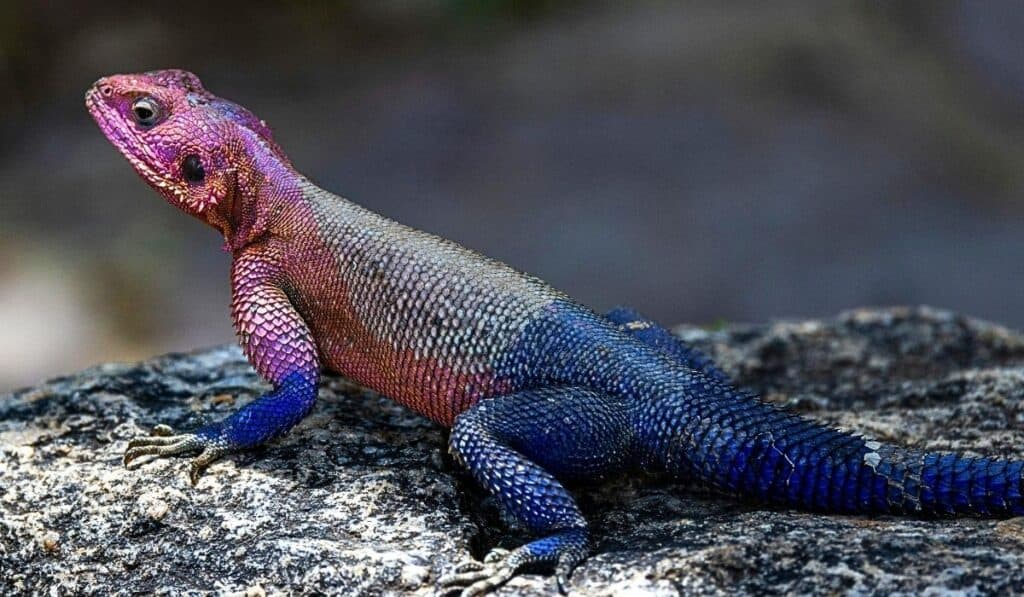
The rock agama lizard looks like it raided a paint store and decided to wear every bright color available.
Males have electric blue bodies with bright orange or red heads that seem to glow in the African sun.
Their colors become even more vibrant during breeding season, when males compete for territories and mates.
Dominant males display the brightest colors, while subordinate males remain dull.
Rock agamas are incredibly acrobatic, performing “push-ups” and head-bobs to communicate with other lizards.
They’re also fast runners, capable of impressive bursts of speed when escaping predators.
These omnivorous lizards eat insects, small vertebrates, and vegetation.
They’re often seen basking on rocks, which is how they got their name.
Found throughout Sub-Saharan Africa, rock agamas thrive near human habitation and are common sights in many African national parks.
Males are territorial and will fiercely defend their rocky outcrops.
88. Spanish Dancer Nudibranch
The Spanish dancer is a large sea slug that looks like it’s dressed for flamenco dancing 💃
When swimming, it undulates its body in rippling, dance-like movements that give it its name.
They can reach 2-feet-long (60 cm), making them one of the largest nudibranchs in the world.
Their bright red and orange coloring warns predators that they’re toxic.
Spanish dancers feed primarily on sponges, storing the toxins from their prey in their own skin as a defense.
They’re immune to these toxins but use them to make themselves poisonous to predators.
These sea slugs are usually seen at night, crawling along reef bottoms.
When disturbed, they swim by undulating their entire body, creating the dramatic dance-like motion.
Found in tropical and subtropical waters of the Indo-Pacific, Spanish dancers lay their eggs in beautiful rose-shaped ribbons that can contain millions of eggs.
89. Basking Shark

The basking shark is the second-largest fish in the world, growing up to 40-feet-long (12 m).
These gentle giants swim with their massive mouths wide open, filtering thousands of gallons of water per hour for plankton.
Their mouths can be more than 3-feet-wide (0.9 m), with hundreds of tiny teeth that play no role in feeding.
Instead, they use gill rakers to strain tiny prey from the water.
Despite their enormous size, basking sharks are completely harmless to humans.
They move slowly and deliberately through the water, often swimming close to the surface where they appear to be basking in the sun.
These sharks migrate long distances, following plankton blooms across ocean basins.
They can dive to depths more than 3,000-feet (914 m) but are most commonly seen at the surface.
Found in temperate waters worldwide, basking sharks are endangered due to overfishing.
Their large fins are valuable in Asian markets, leading to population declines in many areas.
90. Kiwi

The kiwi, New Zealand’s national bird 🇳🇿, is a flightless, chicken-sized bird with hair-like feathers and a long, curved beak.
They’re more closely related to the extinct elephant bird than to any living species.
Kiwis are the only birds with nostrils at the end of their beaks, allowing them to sniff out worms and insects underground.
They have an excellent sense of smell, unusual for birds.
These nocturnal birds are surprisingly aggressive and territorial, with powerful legs that can deliver devastating kicks.
Males incubate the eggs for 80 days; one of the longest incubation periods.
Kiwi eggs are enormous relative to body size, weighing up to 20% of the female’s body weight. It’s equivalent to a human giving birth to a 3-year-old child 🤯
Most kiwi species are threatened, primarily due to predation by introduced mammals like stoats, cats, and dogs.
Conservation efforts include predator-free sanctuaries and captive breeding programs.
91. Southern Cassowary
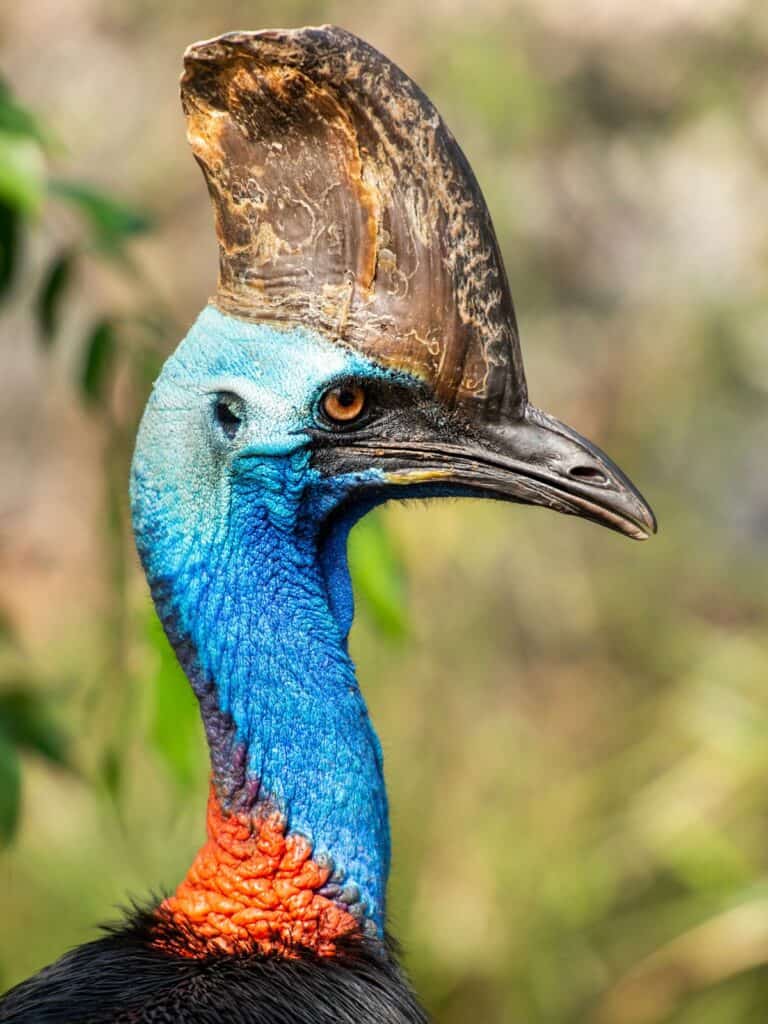
The southern cassowary is often called the world’s most dangerous bird, with powerful legs armed with 5-inch (12.7 cm) dagger-like claws.
These large, flightless birds can disembowel predators with a single kick.
They have a distinctive blue head and neck, red wattles, and a large brown casque (helmet) on their head.
The casque’s exact purpose is debated, though it may amplify sounds or help push through dense vegetation.
Cassowaries are crucial to rainforest health, dispersing seeds from more than 200 plant species.
Some plants depend entirely on cassowaries to spread their seeds.
These birds can run up to 31 mph (50 km/h) through dense forest and jump more than 5-feet-high (1.5 m).
They’re also excellent swimmers, capable of crossing wide rivers.
Found in northeastern Australia, New Guinea, and nearby islands, cassowaries are vulnerable to habitat loss and car strikes.
As rainforests shrink, human-cassowary conflicts increase. There have been two recorded cases of cassowaries killing people.
92. Aardwolf

The aardwolf is a small, shy member of the hyena family that looks like a miniature striped hyena.
Unlike its bone-crushing relatives, the aardwolf feeds almost exclusively on termites.
They can eat up to 250,000 termites in a single night, lapping them up with a wide, sticky tongue.
Their teeth are small and weak, perfectly adapted for their insect diet.
Aardwolves have the ability to squirt a foul-smelling liquid from their anal glands when threatened, similar to skunks 🦨
This defensive spray can deter predators like jackals and eagles.
These nocturnal animals are solitary and mate for life, with pairs defending territories marked by scent secretions.
They rarely vocalize, maintaining a quiet, secretive existence.
Found in eastern and southern Africa, aardwolves live in grasslands and savannas where termites are abundant.
They’re not threatened and adapt well to human-modified landscapes.
93. Magnificent Frigatebird
The magnificent frigatebird has the largest wingspan-to-body-weight ratio of any bird.
Males have a spectacular red throat pouch that inflates like a balloon during courtship displays.
They’re accomplished kleptoparasites, harassing other seabirds until they regurgitate their catch.
Frigatebirds are so reliant on stealing that they’re sometimes called “pirate birds” 🏴☠️
These birds can stay airborne for weeks at a time, riding air currents and even sleeping while flying.
They rarely land on water because their feathers aren’t waterproof.
Male frigatebirds gather in groups, inflating their red pouches and making rattling sounds to attract females flying overhead.
The display can last for hours.
Found in tropical and subtropical waters worldwide, magnificent frigatebirds nest in coastal areas and islands.
They’re not threatened but are sensitive to human disturbance at nesting sites.
94. Pink Dolphin (Amazon River Dolphin)

The Amazon river dolphin, or boto, is the world’s largest river dolphin, turning pink as it matures.
Males develop brighter pink coloration, which becomes more intense when they’re excited or exerting themselves.
These dolphins have unfused neck vertebrae, allowing them to turn their heads 90°, which is useful for navigating flooded forests during wet season.
They’re incredibly flexible compared to oceanic dolphins.
They use echolocation to navigate murky river waters.
According to Amazonian folklore, pink dolphins can transform into handsome men to seduce women, then drag them into the river.
They’re also said to protect drowning people.
Found in the Amazon and Orinoco river basins, pink dolphins face threats from dam construction, pollution, and fishing net entanglement.
Sadly, they’re also often deliberately killed by fishermen who see them as competition for fish.
95. Bilby

The bilby is a rabbit-sized marsupial with enormous ears, a long pointed snout, and a distinctive black and white tail.
These nocturnal diggers are often called rabbit-bandicoots due to their appearance.
The Easter Bilby has become Australia’s answer to the Easter Bunny, with chocolate bilbies sold alongside (or instead of) bunnies.
Proceeds support bilby conservation, raising awareness about these vulnerable marsupials.
These animals are expert burrowers, creating spiral-shaped burrows up to 6-feet-deep (1.8 m).
A single bilby can dig several burrows across its territory for shelter and escape.
Female bilbies have backward-facing pouches, preventing dirt from entering while digging.
They have one of the shortest gestation periods of any mammal, at just 12-14 days.
Once widespread across 70% of Australia, bilbies now occupy less than 20% of their former range.
Introduced predators like foxes and cats, along with habitat loss, have decimated their populations.
96. Slow Loris

The slow loris is a nocturnal primate with enormous eyes and an adorable appearance that masks a dark secret: It’s the world’s only venomous primate.
When threatened, these small, fuzzy creatures raise their arms above their heads, mixing saliva with venom from their elbow glands.
This creates a toxic bite that can cause anaphylactic shock in humans and is painful enough to deter most predators.
Their large eyes are adapted for night vision, and they’re one of the few primates that can digest toxic tree gums and nectars that other animals can’t eat.
Slow lorises move with deliberate, hand-over-hand motions through the forest canopy.
Their slow movement helps them hunt sleeping insects and birds at night without being detected.
Despite their cute appearance and slow movements, these animals should never be kept as pets.
The illegal pet trade is devastating their populations, and captured lorises often have their teeth brutally removed to prevent venomous bites.
Found in Southeast Asia from Bangladesh to the Philippines, all slow loris species are threatened or endangered.
97. Streaked Tenrec

The streaked tenrec is a small hedgehog-like mammal covered in bright yellow and black quills arranged in striking stripes.
Found only in Madagascar, these creatures are more closely related to elephants than hedgehogs.
They can vibrate specialized quills to produce ultrasonic sounds, using stridulation to communicate with other tenrecs.
These are the only mammals known to communicate this way.
When threatened, streaked tenrecs raise their spiny crest of quills and can forcefully detach them, embedding them in predators’ faces.
The barbed quills are difficult and painful to remove.
These insectivores hunt earthworms and other invertebrates in Madagascar’s rainforests.
They’re active during the day, unlike most tenrec species which are nocturnal.
Streaked tenrecs live in family groups and share burrows, unusual social behavior for tenrecs.
The bright warning coloration advertises their painful defensive capabilities to potential predators.
98. Wobbegong

Wobbegongs are bottom-dwelling carpet sharks with elaborate, branching skin flaps around their jaws that look like seaweed or coral.
This incredible camouflage makes them virtually invisible on the ocean floor.
They’re ambush predators, lying motionless on the seafloor and striking at fish that swim too close.
Their camouflage is so effective that divers sometimes accidentally step on them 🤿
These sharks have thick, muscular bodies and powerful jaws capable of inflicting serious bites.
While not aggressive, they will bite if stepped on or harassed.
Some species may use their ornate lobes as lures, waving them to attract curious fish.
There are 12 species of wobbegong found throughout the Pacific and Indian Oceans, primarily around Australia and Indonesia.
They’re fished commercially in parts of Australia, raising overfishing concerns for some species.
99. Celebes Crested Macaque

The Celebes crested macaque (aka crested black macaque) has an impressive Mohawk-style crest of hair and is famous for the viral “monkey selfie” (pictured above).
These highly intelligent primates have expressive faces and are known for their loud vocalizations.
Their wide, toothy “grins” look aggressive, but they’re actually a friendly greeting between troop members.
Social animals living in troops of up to 100 individuals, these macaques have complex social structures.
They communicate through facial expressions, vocalizations, and body language.
Their diet includes fruits, seeds, insects, and small vertebrates.
They’re important seed dispersers in the forests of Sulawesi, Indonesia.
Critically endangered, these macaques face threats from habitat loss and hunting for bushmeat.
Their population has declined by more than 80% in roughly 40 years, making conservation efforts crucial.
100. Giant Siphonophore

The giant siphonophore is one of the longest animals on Earth, capable of growing more than 150-feet-long (46 m), which is longer than a blue whale 🐋
Despite its size, most people have never heard of this bizarre deep-sea creature.
These aren’t actually single animals but colonies of thousands of individual organisms called zooids, each with specialized jobs.
Some sting and capture prey, others digest food, while others handle reproduction.
The translucent, string-like body glows with bioluminescence and dangles in the water like an elaborate living fishing net.
Long, stinging tentacles trail from the main body, catching small fish and crustaceans.
Giant siphonophores live at depths of 2,300-3,300 feet (700-1,000 m) in cold ocean waters worldwide.
They move through the water by jet propulsion, with some zooids contracting to push water and propel the colony.
Found in the deep sea, these bizarre colonial organisms have few known predators due to their extreme habitat and venomous tentacles.
They’re rarely seen by humans, and one of the longest ever recorded was filmed off Western Australia in 2020.
The World’s Weirdest Animals: FAQ
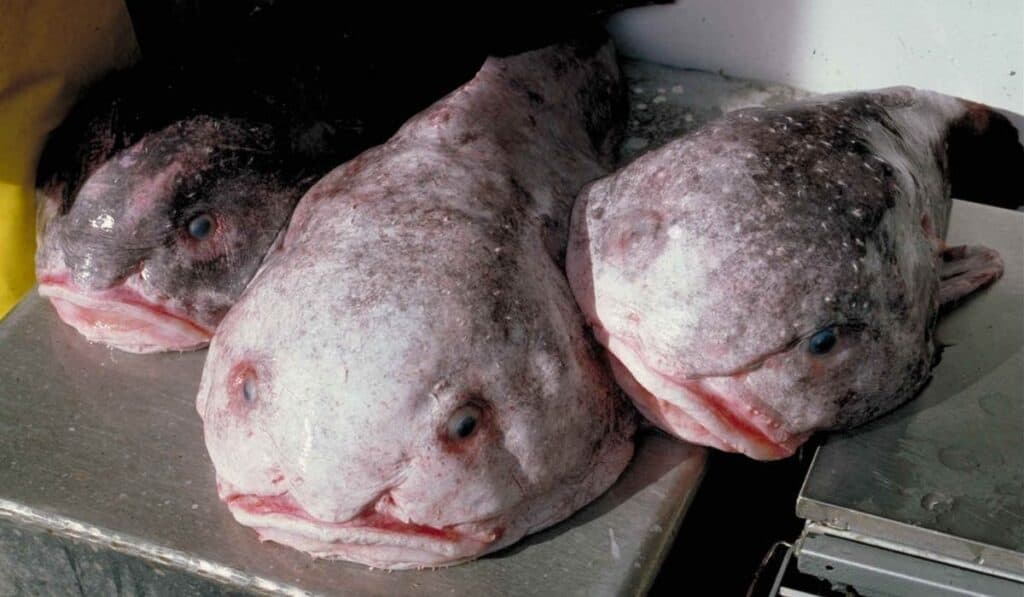
The blobfish’s gelatinous appearance, the axolotl’s regenerative abilities, and the platypus’s impossible combination of features make them strong contenders for the title.
What is the rarest weird animal?
The title here (sadly) goes to the vaquita porpoise, one of the most unique native Mexican animals.
It’s the rarest marine mammal on Earth, with fewer than 10 estimated to remain in the wild 😢
Yes, you read that right — there are only said to be about 10 vaquita porpoises in the wild.
Among the other rarest and weirdest animals, there’s the pink fairy armadillo, which is so rarely seen that scientists can’t even estimate how many are left.
While the saiga antelope used to be on this list, it has made an AMAZING comeback.
Though facing extinction at the turn of this century, Kazakhstan alone counted more than 4.6 million saiga antelope in 2026.
This success is due to major conservation efforts, though threats like disease outbreaks and poaching still remain.
Smaller populations also live in Mongolia, Russia, and Uzbekistan, but the vast majority are in Kazakhstan 🇰🇿
Are weird-looking animals endangered?
Sadly, many unusual animals face extinction threats.

The aye-aye, shoebill, and all eight pangolin species are threatened, endangered, or critically endangered due to habitat loss, hunting, and climate change.
What weird animal has the best survival abilities?
The tardigrade (AKA water bear) wins this category hands down.
These microscopic water bears can survive extreme temperatures, radiation, the vacuum of space, and decades without food or water.
Their cryptobiosis ability essentially allows them to come back from death like zombies 🧟
Why do some animals look so weird?
Strange appearances usually result from specialized adaptations to unique environments or survival strategies.

Of course, these unusual features often provide evolutionary advantages:
- 🌵 Desert animals like the gerenuk have evolved water-conservation systems so they don’t have to drink for long periods of time in arid places where water is scarce.
- 🐟 Deep-sea animals like the anglerfish have developed bizarre features for life in darkness and extreme pressure, like the flashlight attached to the fish’s head.
What is the weirdest deep-sea creature?
It depends on who you’re asking, but the anglerfish is a strong contender for this title.

Other animals like the goblin shark, blobfish, dumbo octopus and sea pigs also all rank among the strangest deep-sea animals.
The extreme conditions of the deep ocean have produced some of Earth’s most alien-looking creatures.
Can you keep weird animals as pets?
Some unusual animals like axolotls can be kept as pets with proper permits and care (though adorable, they’re not social creatures).

It’s better to stick with domesticated animals as pets since the creatures on this weird animals list require specialized environments, are endangered, or are illegal to own.
⚠️ Pro Tip: Always research legality and ethical considerations before considering any exotic pets. Laws can vary from country to country, and state to state.
What’s the largest weird animal?

There are a few bizarre animals that could qualify for the title here, so I will let you decide which you want to give it to.
- The Japanese spider crab holds the title for largest arthropod with a 12-foot leg span (3.6 m).
- On land, the coconut crab is the largest invertebrate.
- The shoebill is one of the largest strange birds in the world at five-feet-tall (1.5 m).
- The whale shark is the largest fish in the sea, with adult females averaging 46-feet-long (14 m), adult males averaging 30-feet long (9 m).
Why are weird animals important?
Unusual animals play crucial roles in their ecosystems and teach us about evolution and adaptation.
They inspire scientific research and medical breakthroughs, like studying axolotl regeneration for human medicine.
Biodiversity, including strange species, keeps ecosystems healthy and resilient.
Where can I see weird animals in person?
Many aquariums and zoos house unusual species like axolotls, nautiluses, and various deep-sea creatures.
Specialized facilities at some of the largest aquariums in the world, like the Monterey Bay Aquarium, Georgia Aquarium, Chimelong Spaceship, S.E.A. Aquarium and L’Oceanogràfic, excel at displaying bizarre marine life.
For wild encounters, consider visiting the Galápagos Islands, Madagascar, or the Great Barrier Reef — or go swimming with the whale sharks in Mexico and see those in person!
In Conclusion: The 100 Strangest Animals You’ve Probably Never Heard Of
From the depths of the ocean to the remotest jungles, Earth’s weirdest animals remind us that nature’s creativity knows no bounds.
These bizarre creatures have evolved extraordinary adaptations that allow them to thrive in the most challenging environments.
Whether it’s the tardigrade’s near-indestructibility, the mantis shrimp’s incredible vision, or the platypus’s impossible combination of features, each weird animal teaches us something new about the resilience and diversity of life on our planet.