10 Fun Facts About Axolotls (And Answers to All the Most Common Axolotl FAQs)

Looking for some fun facts about axolotls?
You’ve come to the right place, as axolotls have become one of the internet’s most beloved creatures, and for good reason.
These perpetually smiling salamanders possess abilities that seem straight out of science fiction, from regrowing entire limbs to maintaining their juvenile features throughout their lives.
Whether you’ve fallen in love with their adorable appearance, discovered them through Minecraft, or are considering one as a pet, understanding these remarkable amphibians deepens your appreciation for their unique biology.
1. Axolotls Can Regrow Almost Any Body Part
The most astounding fact about axolotls is their regenerative superpower.
Axolotls can regrow entire limbs, parts of their spinal cord, heart tissue, and even portions of their brain.
Unlike humans who heal injuries with scar tissue, axolotls regenerate damaged tissue perfectly without any scarring.
They can regrow a leg in about a month, making them one of the most extraordinary regenerative species on Earth.
Scientists study axolotls intensively hoping to unlock secrets that could revolutionize human medicine.
2. Axolotls Never Grow Up

Another one of the most fun facts about axolotls is that they exhibit a fascinating biological phenomenon called neoteny, meaning they retain juvenile features throughout their entire lives.
Rather than undergoing typical metamorphosis, axolotls keep their youthful appearance, including their tadpolelike dorsal fin and feathery external gills that fan out from the head.
Most amphibians transform from aquatic larvae into terrestrial adults, losing their gills and developing lungs for land-based living.
Axolotls skip this transformation entirely, remaining fully aquatic with external gills visible throughout adulthood.
They have both gills and lungs, giving them the ability to breathe both underwater and directly from the air.
3. Baby Axolotls are Cannibals
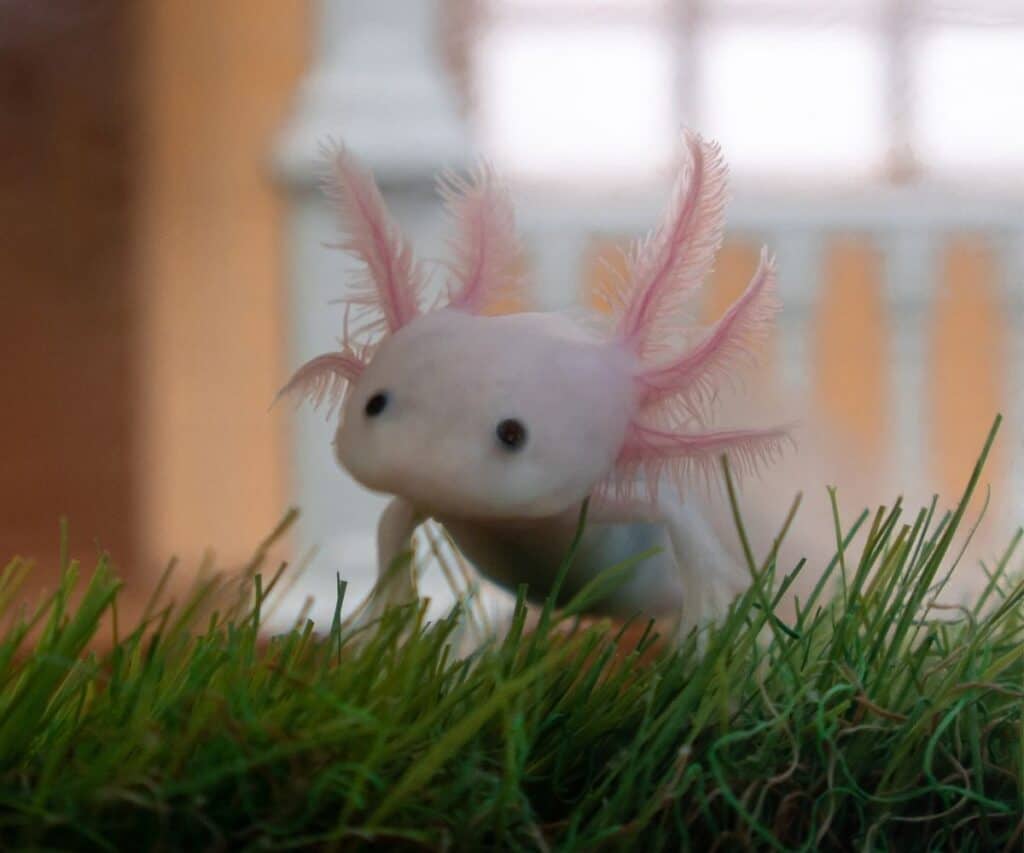
Many young axolotls wouldn’t think twice about having a nibble of their brothers and sisters after they’re born.
Juvenile axolotls are notoriously cannibalistic, biting off and eating each other’s limbs, gills, and tails when housed together.
This cannibalistic behavior means baby axolotls should never be kept together in captivity.
Fortunately, thanks to their remarkable regenerative abilities, these injuries aren’t death sentences.
The bitten axolotl simply regrows whatever was consumed over the following weeks.
4. Axolotls are Named After an Aztec God
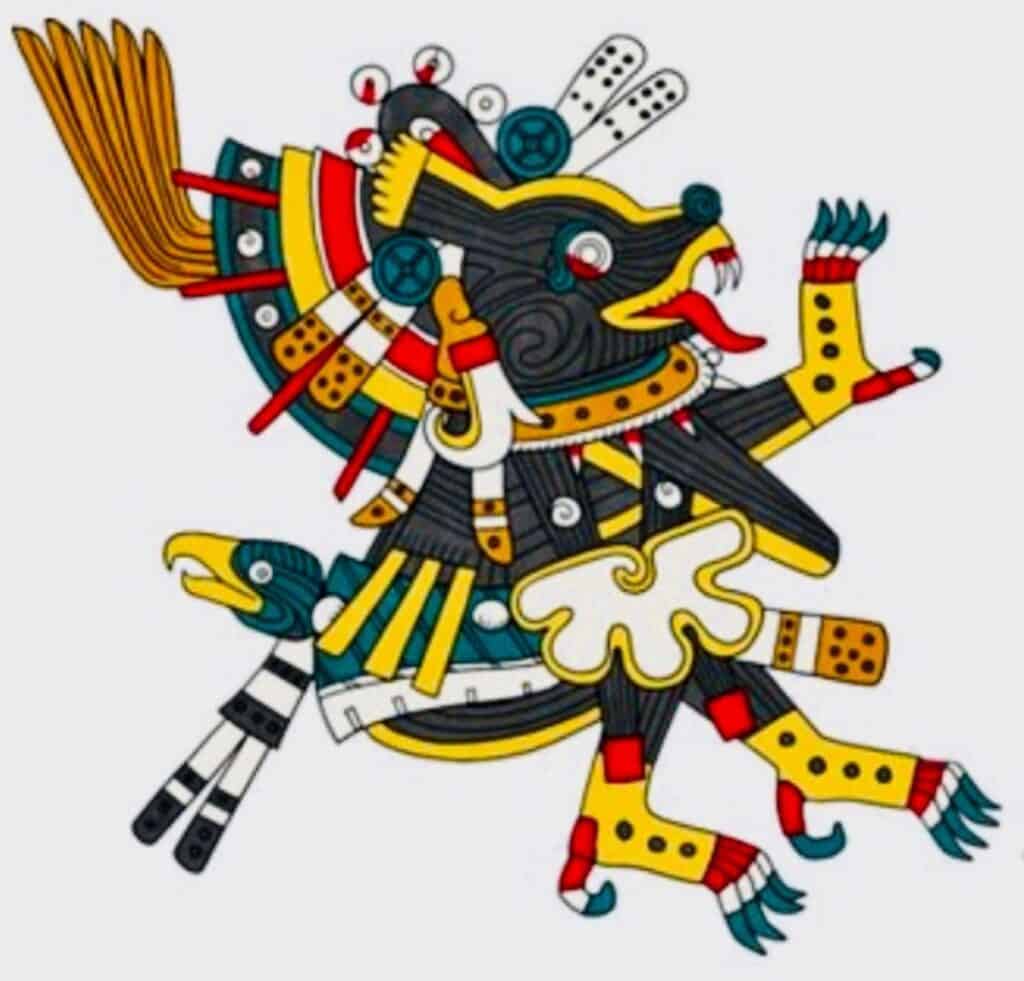
The name “axolotl” was inspired by the Aztec god of fire and lighting, Xolotl, who can turn into a salamander.
In Aztec mythology, Xolotl disguised himself as a salamander to avoid being sacrificed to the sun.
The word “axolotl” translates to “water dog” or “water monster” in the ancient Aztec language of Nahuatl (pronounced nah-wah-tull).
The Aztecs considered axolotls sacred creatures with healing properties.
The correct axolotl pronunciation in the Nahuatl dialect is ah-show-loat (or alternatively, ah-show-loat-tay).
The English pronunciation of axolotl, ack-suh-lah-tuhll, is technically incorrect.
5. Axolotls Appear on Mexican Currency
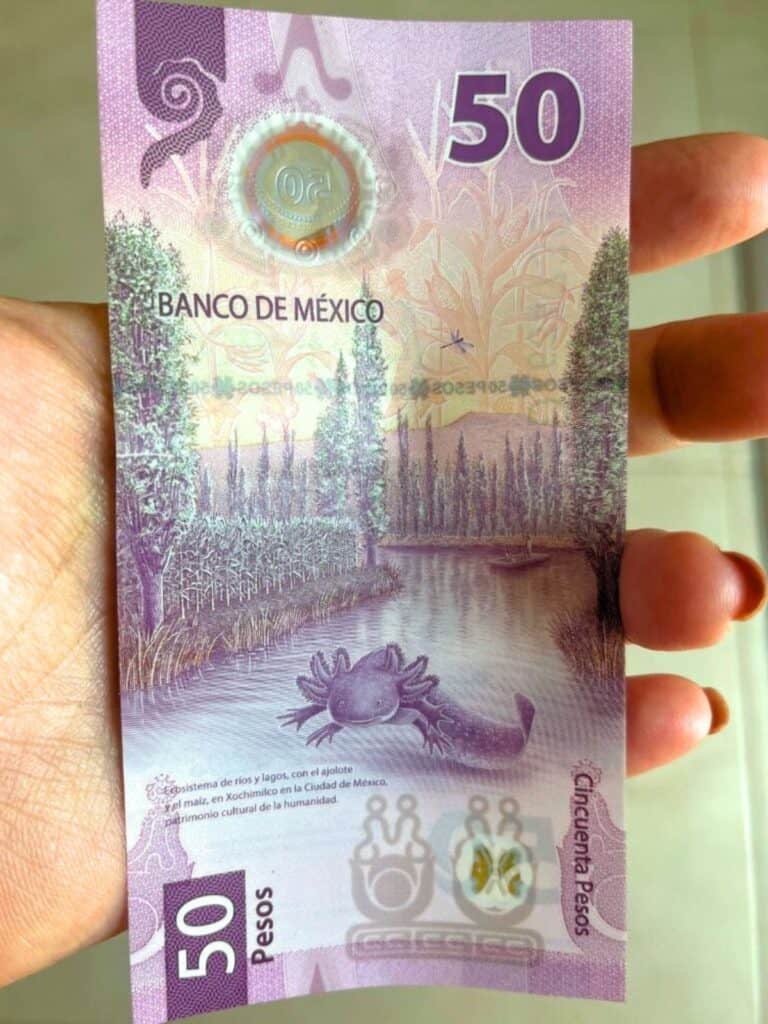
The axolotl is featured on the Mexican 50 peso bill, demonstrating its cultural significance to Mexico.
This national symbol represents Mexico’s unique biodiversity and natural heritage.
The currency design showcases the axolotl alongside images of Lake Xochimilco in Mexico City, its native habitat.
This prominent placement on money helps raise awareness about axolotl conservation.
It’s one of the few amphibians honored on official currency anywhere in the world — and actually won Banknote of the Year in 2021 from the International Bank Note Society for its cultural and ecological celebration.
6. Axolotls Can Run on Their Hind Legs

When threatened or fleeing from predators, axolotls can sprint up to nine miles per hour (14.5 km/h) on their back legs.
This bipedal running behavior helps them move faster and stay cooler by keeping their bodies off the hot ground — and the sight of an axolotl sprinting on two legs is both amusing and impressive.
You’re unlikely to see pet axolotls doing this since it’s typically a fear response. In the wild, this ability allows them to escape danger quickly.
7. Axolotls Have a Third Eye

Axolotls have a parietal eye, which is a small gap in their skull on top of their head that detects movement and shadows.
While many reptiles and amphibians have these, it’s particularly well-developed in axolotls.
Connected to the pineal gland, this “third eye” can’t form images like their regular eyes, but it helps the axolotl sense predators approaching from above.
This remarkable feature gives axolotls awareness of their surroundings in full 360°.
The parietal eye is sensitive to light and helps regulate their circadian rhythms.
8. Axolotl DNA is Ten Times Larger Than Humans
Axolotls have one of the largest genomes ever sequenced, containing more than 32 billion base pairs.
That’s ten times larger than the human genome, making genetic research incredibly complex. Scientists only fully sequenced the axolotl genome in 2018.
This massive genome helps explain their extraordinary regenerative abilities.
Understanding this genetic blueprint could unlock breakthroughs in regenerative medicine for humans.
9. Axolotls Can Accept Transplanted Organs

Axolotls can accept transplanted organs from other axolotls, including eyes and brain tissue.
They restore these “alien organs” to full functionality, integrating them seamlessly into their bodies.
This remarkable immune tolerance makes axolotls unique among vertebrates.
Researchers have successfully transplanted limbs between axolotls without rejection.
This ability provides valuable insights into tissue compatibility and transplant medicine.
10. Axolotls Can Hold Their Breath Underwater for A While

Axolotls are capable swimmers and can hold their breath for up to two minutes at a time.
While they have gills for extracting oxygen from water, they also possess functional lungs.
This dual breathing system provides flexibility in varying water conditions. In the wild, they sometimes swim to the surface to gulp air directly.
The Most Common Axolotl FAQs
What is an axolotl?
An axolotl is an aquatic salamander native to Mexico that exhibits neoteny, retaining juvenile features throughout its life.
These amphibians never lose their external gills or leave the water as adults, growing 6- to 18-inches-long (15-45 cm) with extraordinary regenerative abilities.
Is an axolotl a fish?
No, they’re not fish. Rather, axolotls are amphibians, specifically salamanders.

Despite being called “Mexican walking fish,” they belong to the family Ambystomatidae.
They’re related to tiger salamanders but remain fully aquatic throughout their lives, unlike most amphibians.
Where do axolotls come from?
Axolotls are native to Lake Xochimilco and Lake Chalco in the Valley of Mexico near Mexico City.
They exist in the wild in only this one location on Earth, inhabiting a network of artificial channels, small lakes, and wetlands.
Why is the axolotl endangered?
Axolotls are critically endangered due to habitat loss, pollution, and the introduction of invasive species, like tilapia.
Mexico City’s urbanization has drained and contaminated their native lakes. Invasive fish eat axolotl eggs and compete for food resources.
What are the different types of axolotls?
Axolotl color morphs include wild-type (brown/green), leucistic (pink with black eyes), albino (golden/white with red eyes), melanoid (solid black), and various combinations.
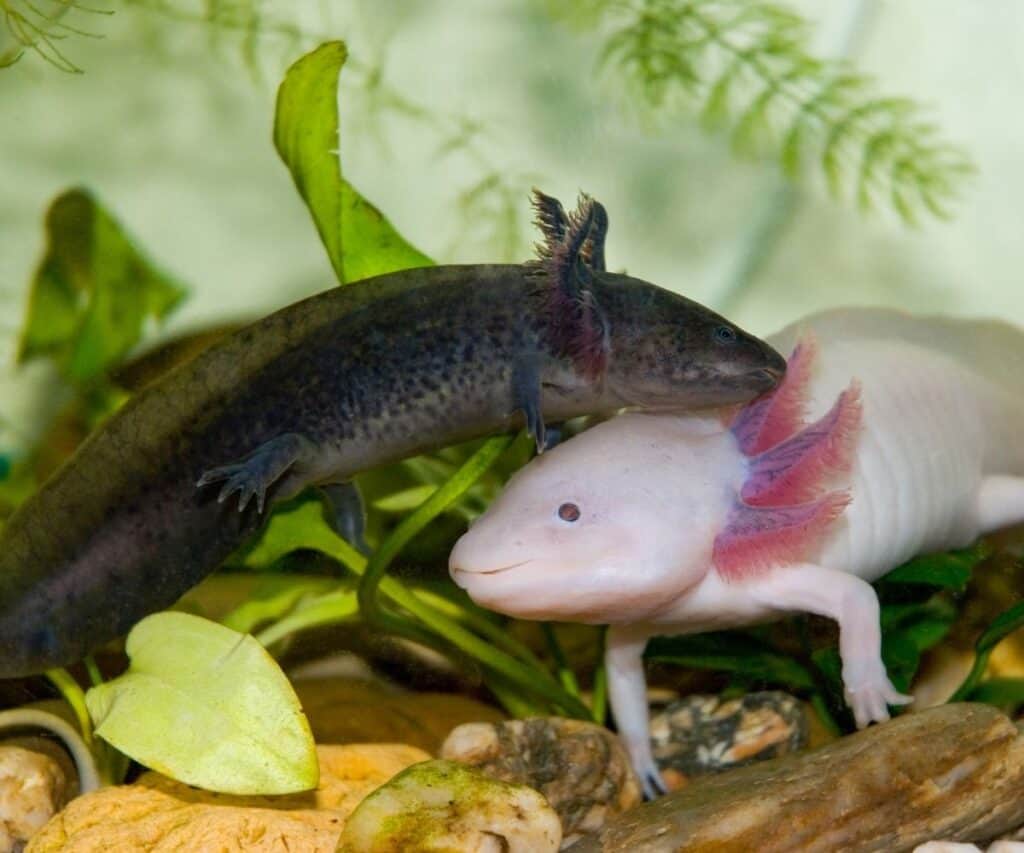
All captive axolotls belong to the species Ambystoma mexicanum, despite color variations.
Do axolotl change color?
Yes, axolotls can change color slightly based on their environment, substrate color, diet, age, and stress levels.
Changes are usually subtle, with colors becoming darker or lighter rather than dramatic transformations. Sick or stressed axolotls may appear paler.
What is a GFP axolotl?
GFP axolotls are genetically modified axolotls that express green fluorescent protein from jellyfish.
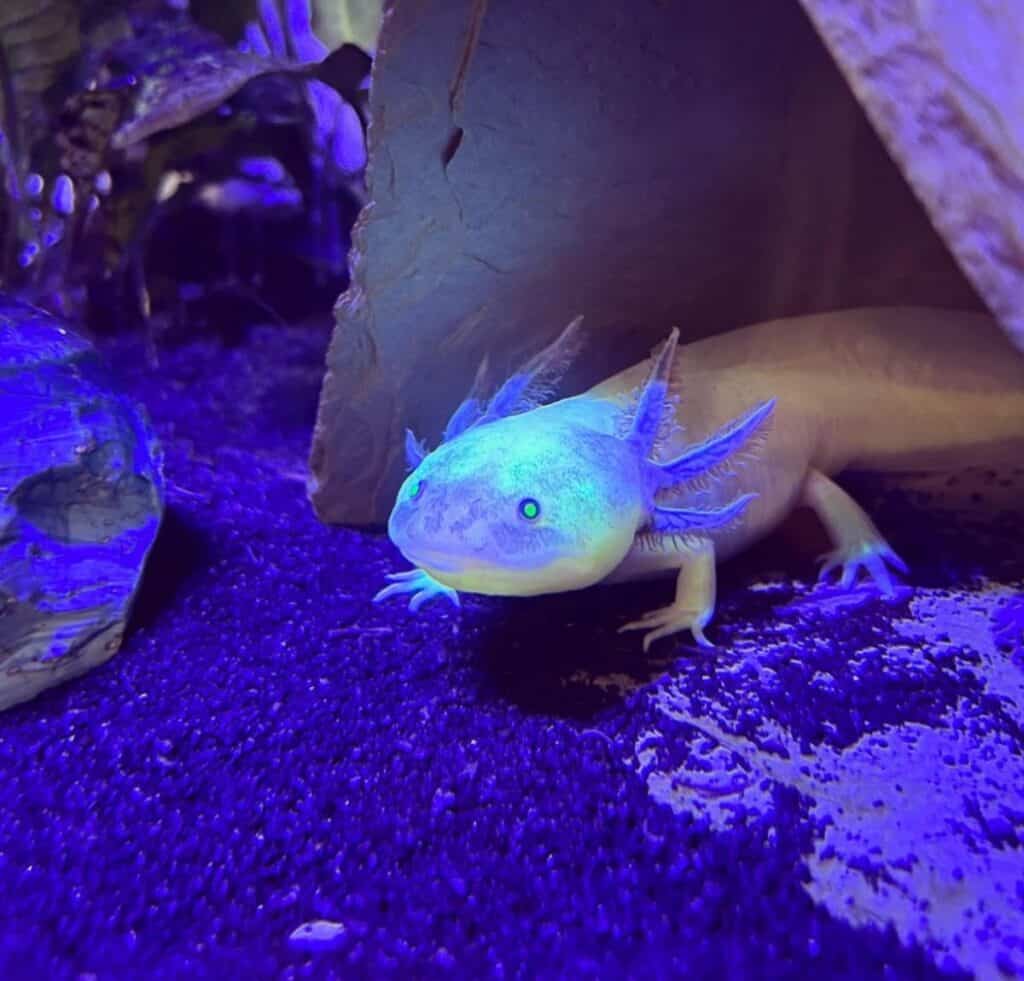
Scientists created GFP axolotls to study limb regeneration and cellular processes.
As they glow bright green under ultraviolet light, this has made it easier to track biological functions.
What is the rarest axolotl?
Wild-type brown or green axolotls are rarest in captivity since most breeders prefer colorful morphs.
In Minecraft, the blue axolotl is rarest with only a 0.083% chance of spawning. True blue axolotls don’t exist naturally in real life.
Is there a blue axolotl?
No, true blue axolotls don’t exist in real life. The blue axolotl appears only in the Minecraft game as an extremely rare variant.
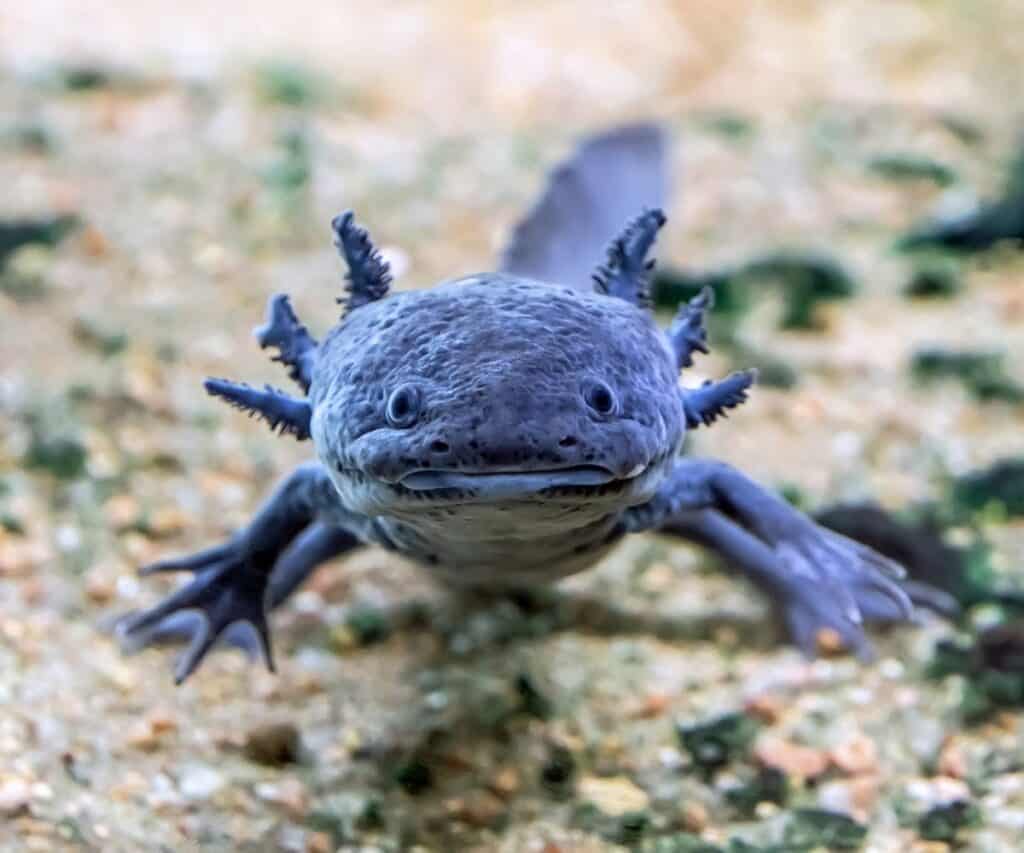
Real axolotls come in wild-type, leucistic, albino, melanoid, and various combination colors — but not blue.
Axolotl vs Salamander: What’s the difference?
While all axolotls are salamanders — not all salamanders are axolotls. The key difference is in the gills and lungs.
- Most salamanders undergo metamorphosis, losing gills and developing into terrestrial adults that live on land.
- Axolotls are neotenic, retaining larval features and remaining aquatic forever, as they don’t lose their gills.
Axolotl vs Mudpuppy: What’s the difference?
Both are neotenic salamanders with external gills, but they have some key differences.
- Mudpuppies (Necturus species) live across North America, while axolotls one of the animals native only to Mexico.
- Axolotls have three-toed feet, while mudpuppies have four-toed feet.
- Compared to mudpuppies, axolotls possess superior regenerative abilities compared.
- Mudpuppies are usually larger than axolotls.
Is an axolotl a lizard?
No, axolotls are amphibians; they’re not reptiles like lizards are.

While they’re similar in appearance, there are key differences that distinguish lizards vs axolotls.
- Lizards are reptiles with scales, while axolotls have moist, permeable skin.
- Amphibians undergo aquatic larval stages and breathe through gills at some life stage, characteristics lizards never possess.
How long does it take for an axolotl to grow?
Axolotls reach sexual maturity at 18-24 months and their full size of 9-12 inches (23-30 cm) in 1.5-2 years.
Growth rate depends on water temperature, feeding frequency, and genetics.
They continue slow growth throughout their lives, with size typically peaking around 2-3 years.
Can an axolotl regrow its head?
No, axolotls cannot regrow their entire head, so decapitation is fatal.
However, they can regenerate portions of their brain, jaw, eyes, and facial structures.
While axolotls can also regrow limbs, their tail, gills, heart tissue, and portions of the spinal cord, complete head regeneration exceeds their regenerative capabilities.
Can an axolotl regrow its brain?
While they can’t regrow the entire brain, axolotls can regenerate portions of their brain, particularly the brain’s less vital regions. They can also repair significant damage to brain tissue.

This remarkable ability makes them valuable subjects for neuroscience research and regenerative medicine studies.
There are many scientific studies on the axolotl currently ongoing to learn more about this.
Are axolotls poisonous?
No, axolotls are not poisonous or venomous and they pose no toxicity threat to humans or other animals.
Their skin secretes mucus for protection and moisture retention, but this mucus isn’t harmful to humans, so axolotls are safe to keep as pets (though they don’t make great pets — more on that below).
Do axolotls bite?
Axolotls can bite but rarely do unless they’ve mistaken human fingers for food.
If a bite happens, it feels more like gentle pressure rather than painful punctures.
The bites are harmless because axolotls lack teeth, and aren’t able to break human skin.
Axolotls use suction feeding to consume prey, which allows them to capture food without biting.
Are axolotls blind?
No, axolotls have functional eyes and poor vision, but they do have some amount of eyesight.

While not technically blind, their eyesight is significantly limited compared to other animals.
They rely primarily on smell and detecting water movement to locate food. Theirlateral line system senses vibrations.
How big is an axolotl?
Adult axolotls typically reach 9-12 inches in length (23-30 cm), though some grow up to 18 inches (45 cm).
Males are generally slightly larger than females.
Size depends on genetics, diet quality, and environmental conditions during growth.
How long do axolotls live?
Axolotls usually live 10-15 years in captivity with proper care. The oldest recorded captive axolotl lived over 25 years!
In the wild, their lifespan is much shorter, typically only 5-6 years, due to predation, disease, and environmental factors.
Can you have an axolotl as a pet?
Yes, axolotls can be kept as pets in most places, though they’re illegal in some U.S. states like California and New Jersey.
Pet axolotls require specialized care including cool water of about 60-64°F (15-17°C), proper filtration, and specific dietary needs.
In general, they don’t make great pets (the video above explains several reasons why).
⚠️ Axolotl Pro Tip: Proper research into axolotl pets is essential before acquiring one.
The linked website, Axolotl Planet, is a wealth of knowledge on keeping an axolotl as a pet. If you’re considering an axolotl pet, check it out first.
How do you take care of an axolotl?
Axolotl care requires a 20+ gallon tank (75 L) with cool water of 60-64°F (15-17°C), gentle filtration, hides, and bare bottom or fine sand substrate.
Feed earthworms or carnivore pellets 2-3 times weekly for adults.
Maintain pristine water quality with regular testing and 20% weekly water changes.
How much are axolotls?
Axolotls typically cost $20-$70 depending on the color morph, with rare colors commanding higher prices.
GFP axolotls (aka glow in the dark axolotls) cost more, at about $150-$350 each.
Initial setup expenses including tank, filter, and supplies range from $200-$400. Ongoing costs include food and water conditioning supplies.
Can you have more than one axolotl in a tank?
Yes, but with some caveats. In fact, many keepers (and the axolotl themselves) prefer single-axolotl tanks.

- The axolotls in the same tank should be of similar sizes.
- Baby axolotls should never be housed together due to cannibalism.
- You need to add 10 gallons (38 L) of water per additional axolotl beyond the first, which requires at least 20 gallons (75 L). This means the minimum tank needed for two axolotls is 30 gallons (114 L).
- Provide multiple hiding places for them so they can avoid each other.
- Monitor the tank for aggression with the understanding that you might have to separate them.
Can axolotls live on land?
No, axolotls cannot live on land as they’re fully aquatic and die within minutes out of water, so axolotls must remain underwater throughout their lives.
While forced metamorphosis so they’re made to fully develop lungs is something that can be artificially induced through hormones, this is extremely stressful, unethical, and significantly shortens their lifespan.
What can axolotls live with?
For this animal to be happiest, axolotls are best kept alone as they’re not naturally social creatures.
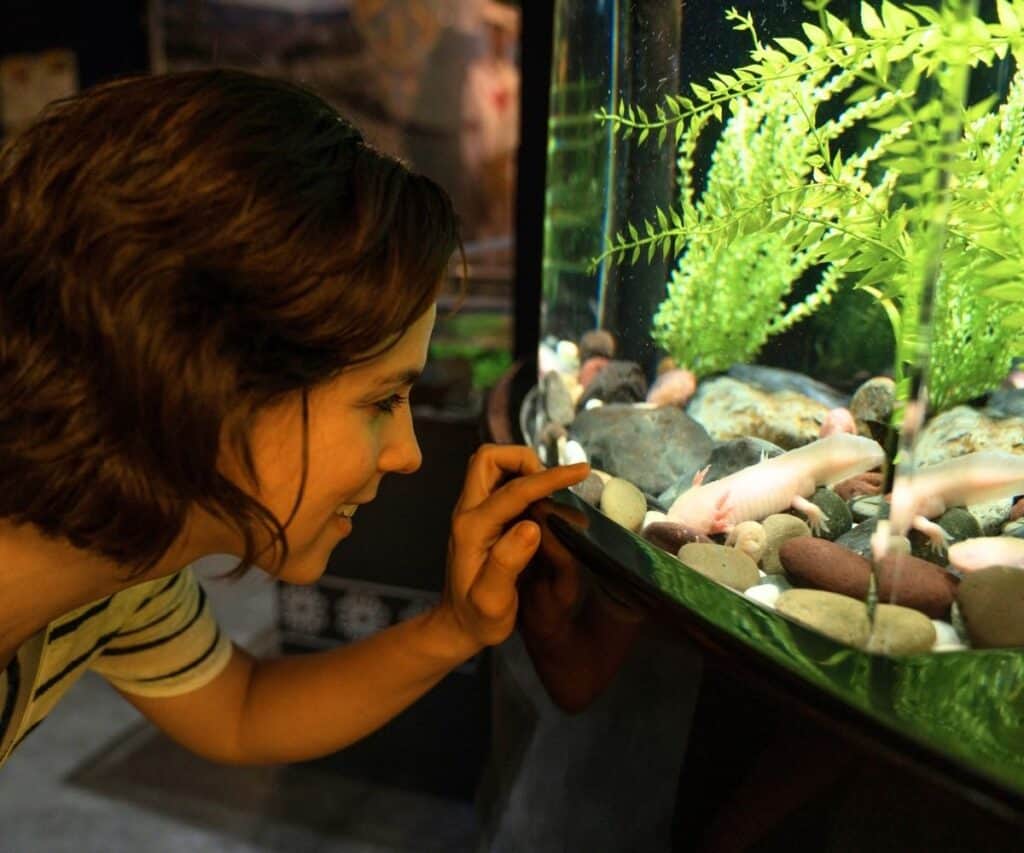
They can live with shrimp (though the shrimp may one day become food) and certain minnows, making axolotl tank mates risky.
Most fish will bite the axolotl gills, and/or get eaten by the axolotl for attempting to.
Snails and bottom feeders compete for food with the axolotl, and can stress the axolotl out, which often leads to their early demise.
What do you feed an axolotl?
Adult axolotls eat earthworms, nightcrawlers, blackworms, and carnivore pellets 2-3 times weekly. Juveniles eat daily.
Avoid feeding wild-caught prey, feeder fish (because of disease risk), and hard foods that could cause impaction.
Food should be appropriately sized for their mouth.
Can you hold an axolotl in your hand?
Yes, but you shouldn’t because axolotls dislike physical interaction with people and get stressed easily.

They’re more “observational pets” that you look at but don’t touch.
You should minimize handling axolotls because their delicate, permeable skin absorbs oils, soap, and bacteria from human hands.
If necessary, use clean, wet hands or a soft net and support their entire body when moving them.
Brief handling for tank maintenance causes them less stress than prolonged contact.
What is a baby axolotl called?
There’s no specific technical term like “tadpole” for frog babies, so many keepers simply call them “baby axolotls.”
You can also technically call baby axolotls larvae or juveniles.
The babies hatch from eggs after about two weeks and look like miniature adults with proportionally larger gills.
Are axolotls endangered?
Yes, axolotls are endangered animals in the wild according to the IUCN Red List.
In fact, axolotls are listed as “critically endangered with decreasing populations.”
Scientists estimate only 50-1,000 adult individuals remain in Lake Xochimilco in Mexico City.
Despite wild scarcity, millions thrive in captivity worldwide for research and as pets.
How many axolotl are left in the world?
Scientists estimate there may be fewer than 1,000 axolotls left in their native habitat.
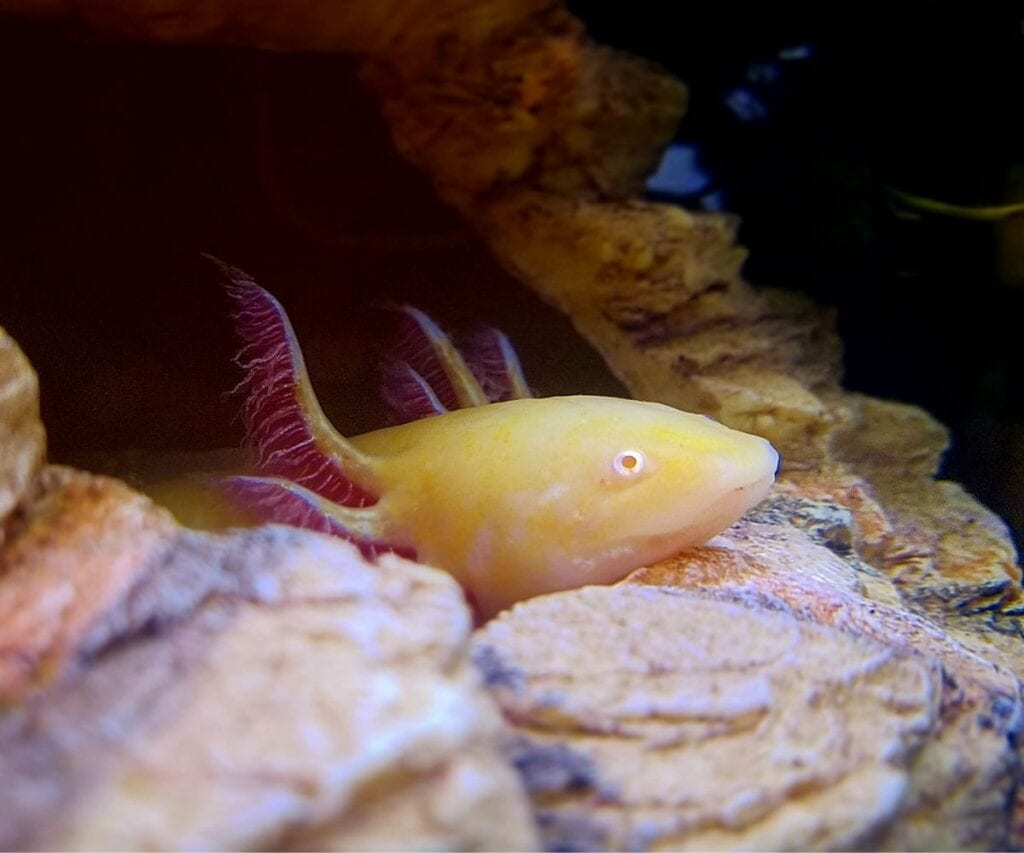
Wild populations have crashed due to habitat loss, pollution, and invasive species.
Captive axolotl populations number in the millions globally, though these cannot easily be reintroduced to the wild, so the wild axolotl population is absolutly on the brink of extinction 🥺
Can you eat axolotl?
Eating wild axolotls is both unethical and illegal due to their critically endangered status.
Though axolotls are technically edible and were historically consumed in Mexico as a delicacy — that was centuries ago.
Today, even consuming captive-bred axolotls, while not illegal everywhere, raises significant ethical concerns because there are so few wild axolotls left in the world.
What can we do to help axolotls?
One of the ways you can help is by adopting an axolotl through the Adoptaxolotl Program.

Spearheaded by Mexico’s UNAM University, the program raises funds for axolotl habitat rehabilitation.
Habitat loss has been a big factor in their downfall, but the Mexican government and local conservation groups have been restoring their freshwater habitat near Lake Xochimilco for a few years now.
Of course, that’s a slow process.
Another one of the main issues is that captive-bread axolotls don’t survive for long when placed in the wild.
However, scientists have been releasing captive-bred axolotls into artificial wetlands near Mexico City with some success.
This gives us some hope that these captive-bread axolotls will breed, and their wild axolotls offspring well also breed, giving the wild axolotl a chance to make a full comeback.