🇸🇮 10 Fun Facts You Don’t Know About the National Animal of Slovenia (#8 Is Crazy!)

When you think of Slovenia, you might imagine stunning alpine lakes, medieval castles, or incredible cave systems.
But did you know this small Central European nation chose a national animal so elegant that European royalty spent centuries breeding the perfect specimens.
We’re talking about the Lipizzaner horse (aka Lipizzan horse), which holds the title as the national animal of Slovenia.
These intelligent white horses with their roots in the Slovenian town of Lipica represent grace, tradition, and centuries of careful breeding.
Below are 10 fascinating and fun facts about the national animal of Slovenia that will make you want to visit the oldest stud farm in Europe.
1. Lipizzaners are Named After a Slovenian Town

The Lipizzaner horse breed gets its name from Lipica (or, Lipizza in German), a small town in southwestern Slovenia that has become a popular tourist center.
In 1580, Archduke Charles II of Austria established this stud farm in Lipica to breed horses for the Habsburg royal family.
The location was chosen for its excellent climate, limestone-rich pastures, and proximity to the sea, which aided in the horses’ development.
For more than 440 years, Lipica has been breeding these incredible horses — making it one of the oldest continuously operating stud farms in the world.
The Lipizzaner horse breeding traditions of Lipica were awarded UNESCO Intangible Cultural Heritage status in 2022, giving this area a major tourism boost.
Visitors can tour the stables, watch training sessions, and see the famous dancing white stallions perform.
The people of Slovenia are no doubt extremely proud that this iconic horse breed carries the name of a Slovenian town.
2. Lipizzaner Horses are Not Born White
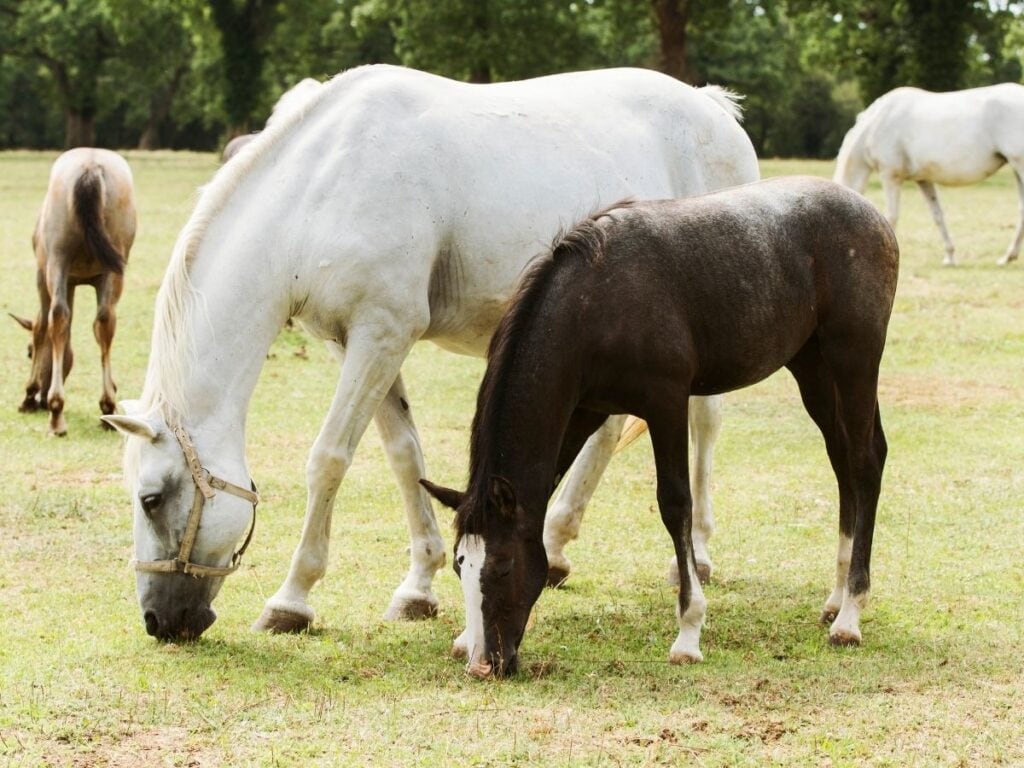
Here’s something that surprises most people: Lipizzaner foals (which are baby horses) are born dark brown or black.
Actually, 1 in 100 Lipizzaners (aka Lipizzans) are born pure white, but the rest start out dark in color and turn white over time.
As they age, their coat gradually lightens through a process called graying, eventually becoming the signature white color by age 6 to 10.
Some Lipizzaners don’t fully turn white until they’re 12 years old, or even older in some horses.
The graying happens because of a dominant gene that causes progressive loss of pigmentation.
Occasionally, a Lipizzaner will remain a reddish-brown (known as “bay”) for life, and these rare horses are considered lucky charms 🍀
The Spanish Riding School in Vienna traditionally keeps at least one bay colored Lipizzaner in their stable for good luck.
3. The Lipizzan Spanish Riding School Has Nothing to Do with Spain

Despite being called the Spanish Riding School, Vienna’s famous institution has zero connection to Spain the country — nor the animals of Spain.
The name comes from the Spanish horses that were originally imported to Austria in the 1500s and 1600s.
These Spanish horses from the Iberian Peninsula were crossed with local horses and Italian breeds to create the Lipizzaner.
So “Spanish” refers to the horses’ ancestry; not the location of the Spanish Riding School 🐎
The riding school, established in 1572, is one of the oldest classical riding academies in the world.
The horses perform incredible movements like the “airs above the ground” where the horse leaps completely off the ground.
Only Lipizzaner stallions are allowed to perform at the school, and for many years, only men were allowed to train and ride them.
However, the school began accepting female riders in 2008. Women are now part of the training and performance teams as well.
4. Lipizzaners are One of the Smartest Horse Breeds

The national animal of Slovenia is renowned for exceptional intelligence and trainability.
Lipizzaners (aka Lipizzans) excel at classical dressage, which requires memorizing complex sequences and responding to subtle rider cues.
They can learn and perform movements like the capriole (a leap where the horse kicks out with hind legs while airborne) and the levade (balancing on hind legs at a 45° angle).
These movements require immense strength, balance, coordination, and mental focus, and most horse breeds can’t do them.
Training a Lipizzaner for the Spanish Riding School takes 6 to 8 years of daily work.
The horses must be mentally sharp enough to remember routines, physically disciplined enough to execute them perfectly, and calm enough to perform in front of loud audiences.
Lipizzaners are also known for strong personalities, and they can be stubborn if they don’t respect their trainer.
5. This Slovenian Lipizzaners Farm Has Been Operating for Almost 450 Years

The Lipica Stud Farm in Slovenia has been continuously breeding Lipizzaners since 1580, making it one of the oldest businesses of any kind in Europe 😱
For more than four centuries, through wars, regime changes, and political upheavals, Lipica kept breeding these horses.
The stud farm maintains meticulous records going back hundreds of years, tracking the bloodlines of every single horse.
Today, Lipica is home to about 300 Lipizzaner horses and receives thousands of visitors annually.
The farm offers tours, riding lessons, carriage rides, and performances; just visit their website (linked above) to book.
Slovenia treats Lipica as a national treasure, and the horses are ambassadors for Slovenian culture worldwide.
Seeing Lipizzaners at their ancestral home in Slovenia is like visiting the source of a centuries-old tradition.
6. Lipizzaners Live Exceptionally Long Lives

The national animal of Slovenia has impressive longevity compared to most horse breeds.
Lipizzaners (aka Lipizzans) regularly live 30 to 35 years, with some reaching their late 30s or even early 40s.
For comparison, the average horse lifespan is about 25 to 30 years, so Lipizzaners consistently exceed expectations.
This longevity is partly due to careful breeding that emphasizes health and hardiness, not just appearance.
Lipizzaners also mature slowly, not reaching full physical development until age 7 or 8. Conversely, most horses mature by 5 or 6.
This slow maturation means they can perform high-level dressage work well into their 20s.
Some Spanish Riding School horses perform publicly until age 25 or older before retiring to greener pastures.
7. The Breed Has Almost Gone Extinct Multiple Times

The Lipizzaner breed of horses has faced extinction threats repeatedly throughout history.
During the Napoleonic Wars (early 1800s), breeding stock was scattered across Europe to protect it from invading armies.
World War I (1914 to 1918) disrupted breeding programs, and many horses were lost.
World War II (1939 to 1945) nearly destroyed the breed entirely — hence the dramatic 1945 rescue mission we mention below in fun fact #8.
After WWII, the Iron Curtain divided Europe, separating breeding populations and threatening genetic diversity.
Today, Lipizzaners are considered a rare breed with only about 3,000 purebred horses worldwide.
Slovenia, Austria, and a few other European countries maintain breeding programs to preserve genetic diversity.
The breed’s survival depends on continued careful management and international cooperation.
8. Lipizzaners Were Rescued During WWII in a Dramatic Mission
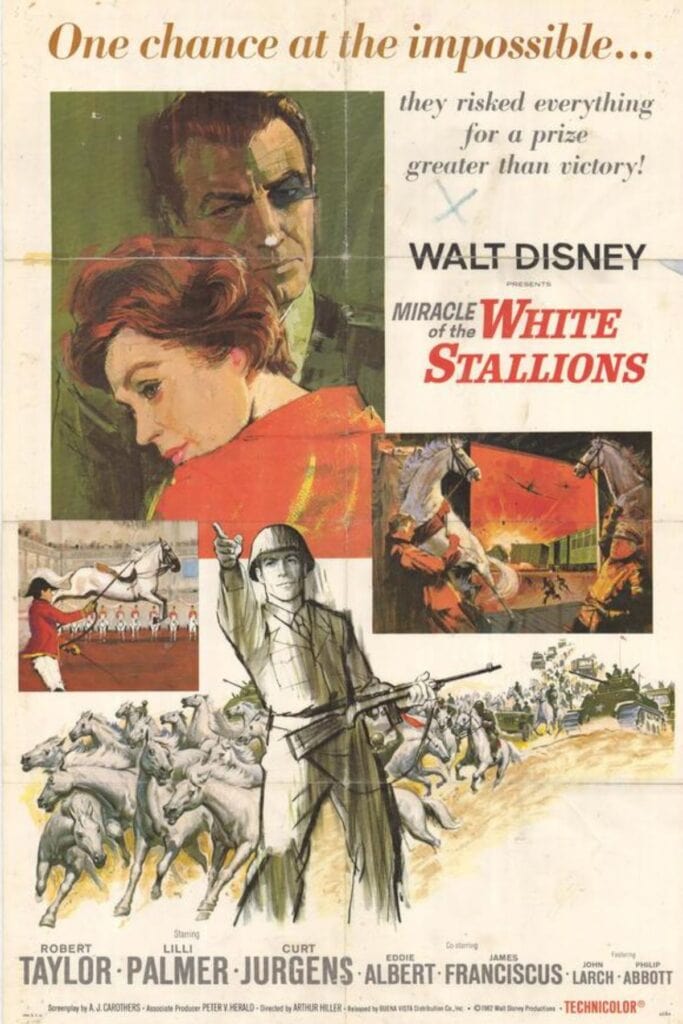
During World War II, the Lipizzaner breed almost went extinct in a story worthy of a Hollywood movie — and it actually became one (keep reading for more info).
As the war raged, the horses at the Spanish Riding School in Vienna were in danger, and the breeding stock at Hostau (now in Czech Republic) faced certain destruction.
In 1945, American General George Patton authorized Operation Cowboy, a daring rescue mission to save the Lipizzaners.
American soldiers, with help from German forces (which was one of the war’s strangest alliances), evacuated approximately 200 Lipizzaner horses to safety.
The mission succeeded, and the horses were eventually returned to Austria and Slovenia after the war.
Without this dramatic rescue, made possible by opposing forces in the war, the Lipizzaner breed might have been lost forever.
The circumstances of their rescue were so interesting that Disney made a film about it called Miracle of the White Stallions.
9. Lipizzaners Appeared on Slovenian Coins

Before Slovenia adopted the euro in 2007, the country’s currency was the Slovenian tolar.
The Lipizzaner horse was featured on the Slovenian 10 tolar coin (seen in the picture above), emphasizing its status as a national symbol.
As Slovenia wanted to showcase its unique cultural heritage on its currency, the Lipizzaner was an obvious choice.
When Slovenia switched to euros, it lost the opportunity to feature national animals on everyday currency.
However, Slovenia issued commemorative euro coins featuring Lipizzaners for collectors (and horse lovers 🐴).
The horse remains a powerful symbol of Slovenian identity even without appearing on regular money.
Slovenia also featured other unique animals from the country on pre-euro coins like the olm (a cave-dwelling salamander) 🪱 and the Carniolan honeybee 🐝
10. You Can Still Ride Lipizzan Horses in Slovenia Today

Unlike many national animals that you can only see in zoos or the wild, Slovenia’s national animal is accessible to visitors.
The Lipica Stud Farm offers riding lessons, dressage training, and carriage rides using actual Lipizzaner horses.
You can take beginner lessons or advanced dressage training depending on your skill level.
The farm also offers Lipizzaner experiences where you can groom, feed, and interact with the horses up close.
For non-riders, there are daily performances showcasing classical dressage and the horses’ incredible abilities.
The farm has a hotel on-site, so you can stay overnight and wake up surrounded by Lipizzaners.
Visiting Lipica is one of Slovenia’s top tourist experiences, combining history, nature, and interaction with these magnificent animals.
Our Final Thoughts on Lipizzaner Horses, the National Animal of Slovenia

The national animal of Slovenia represents elegance, tradition, and centuries of careful stewardship.
From a small Slovenian town, the Lipizzaner breed became one of the world’s most recognizable horses, performing in Vienna, surviving wars, and captivating audiences worldwide.
These intelligent white horses (that actually start life dark brown and turn white over time) embody everything Slovenia values: Quality, heritage, and beauty.
Whether watching them perform classical dressage or simply admiring their grace, Lipizzaners remind us that some traditions are worth preserving, no matter the cost.